Community-Led Conservation: Learning Agency, Tenacity, and Solidarity from the Ground Up
Johan-Arango Quiroga explains his inspiring journey from engineering towards environmental justice.
By Johan Arango-Quiroga
I’m an agroindustrial engineer by training, where I learned a lot about food systems—and also a lot of the wrong things. After working in the food industry for a while, I realized that wasn’t my path and made an intentional shift toward environmental justice, moving from my engineering background into the social sciences. Even though I was trained in quantitative methodologies as an engineer and during my master’s, I found myself increasingly drawn to engaging directly with communities. That is what led me to the PhD in Public Policy at Northeastern University, where I’ve deliberately sought out experiences with participatory methods—photovoice for energy equity work with Latinx communities in Boston and digital storytelling with communities in Ecuador focused on conservation efforts.
My research focuses on community-led conservation and environmental governance, and specifically on understanding how community practice translates into policy and law. I’m currently writing my dissertation using meta-ethnographic methods to examine how Indigenous Peoples’ and Local Communities’ experiences of implementing conservation are captured—or erased—in scholarship. I’m also conducting a case study in Ecuador’s Intag Valley, where communities have resisted mining for 30 years and continue to do so despite ongoing challenges, including government occupation of their territories.
Originally from Colombia and having lived in the US for years, I’ve always straddled multiple worlds in my work. Before my PhD, I served on Salem, Massachusetts’ Food Policy Council, using community-based participatory methods to improve food access and helping secure grants to transition the city farm to solar-powered energy storage. I also worked to integrate the Council into City Government to establish a direct line with municipal decision-makers. Most recently, during fieldwork in Otavalo, Ecuador, I experienced the national strike firsthand. When the strike disrupted my research plans, I joined the community kitchen led by Indigenous women—an experience that deepened my understanding of the conditions the Kichwa People face.
Given the current climate for Latinx communities and migrants of color in the US, my family and I have decided I’ll complete my final dissertation year conducting fieldwork in South America before seeking scholarly paths outside the US. This decision isn’t without contradiction—I believe deeply in showing up for communities, and leaving the US means stepping back from some of that work. But it’s also about recognizing where I can show up most safely and effectively given my positionality and the current political moment.
Community-led conservation has become more than a research topic for me—it’s been an education in marginalization, agency, and tenacity. It’s shaped my commitment to being a scholar who operates on principles of solidarity and partnership. I see this aligning with POLLEN’s mission through collaborative research practice that centers community knowledge and challenges the dominant paradigms reinforcing the extractive activities driving our social and environmental crises.
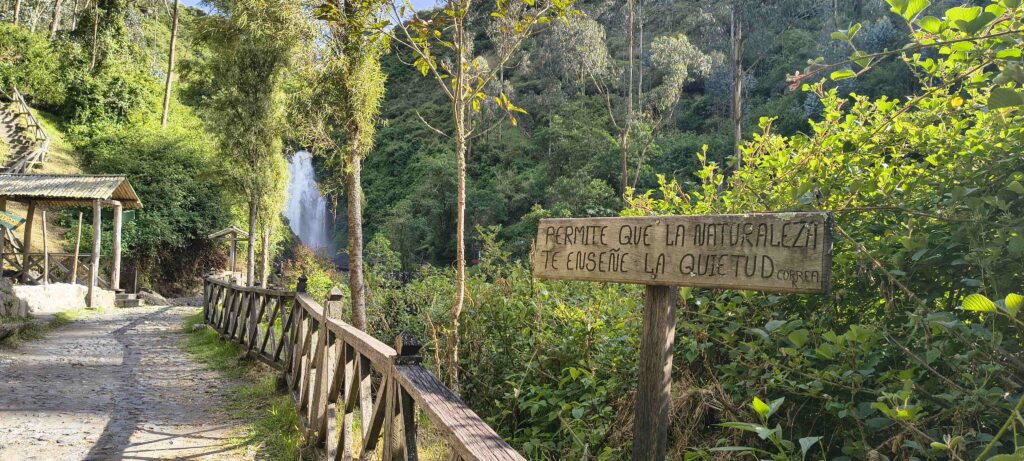
Image: La Cascade de Peguche in Otavalo, Ecuador