POLLEN 2026 – What did everyone make of it?
By Dan Brockington
So POLLEN 2026 has come and gone. What did we make of it all, and what can we collectively learn from it?
After the conference we sent out a survey to all the participants asking them what worked, what did not, and if they had any other comments, all giving anonymous free text answers. We received nearly 400 responses which I have parsed into a rather lengthy report (here). If ever you are organising a large POLLEN conference, or indeed any large conference, there will be some useful insights in it. I hope this report will be an important resource for meetings to come in the future. This blog highlights the main features of it.
There were many people who were happy with the conference, especially its content and organisation, and their feedback was on occasion exuberantly happy, as the excerpt below illustrates. The most mentioned feature was that people loved the quality, especially the diversity, of the content of the conference, the second most salient feature was how much they appreciated the organisation, particularly NomadIT’s role.
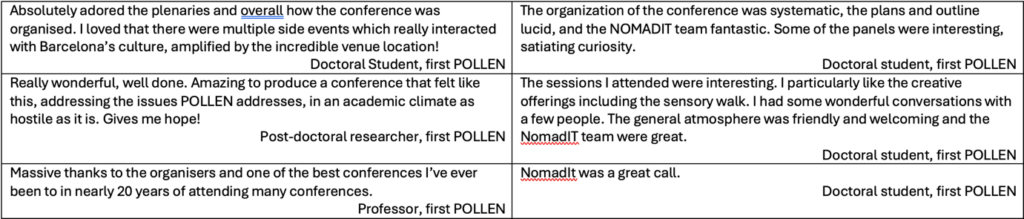
But we can learn more from the more critical voices – and there was a great deal of constructive criticism that was helpfully provided in the feedback. I focus more on that below.
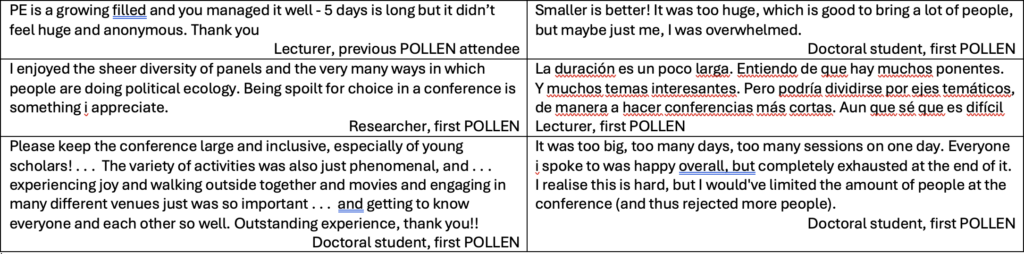
First, for many people this conference was too large. Large conferences become overwhelming. There is fear of missing out and going to the ‘wrong’ panel, fear that you might not be networking effectively, and larger conferences are just more tiring, especially in hot places like Barcelona. But while this was probably the majority view when it came to the size of the conference, it was not the only view. Others welcomed its size – and many welcomed the breadth of content. I have illustrated the contrast below.
Barcelona was a popular venue which may have brought more people along, but regardless of the location, in the future, the likelihood is that demand to attend POLLENs will increase. More and more people will want to come as political ecology grows as a discipline / lens for understanding environmental challenges. We need to develop robust ways of managing that interest.
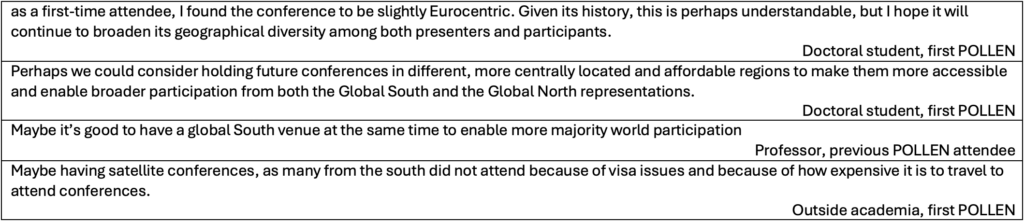
The first step to a robust response will be to listen to the people who were excluded from POLLEN 2026. Clearly it was hard to canvass the view of excluded people in a survey of attendees, but we did receive one view.

If POLLEN is to cope with the interest its success has created it cannot just become more exclusive – rejecting more and more people. Instead, here are some alternatives. First, the gatherings could be held more frequently. Fewer people will all want to come to the same meeting if there are more to choose from. Second, more frequent gatherings could be held on more specific topics, reducing demand by restricting the scope of the calls. Third, we could be more restrictive about conference activities so that attendees can do only one of either presenting, or convening, or organising something alternative. Currently attendees can do all three. Restricting the activities would spread the opportunities more widely.
The call for more meetings also matches our need to meet beyond Europe. Meetings here are more expensive, and harder to get to for colleagues in the global South. Having more meetings and having them beyond fortress Europe could allow us to become more inclusive, while also avoiding isolated super-large gatherings.
Another way of tackling the problem of size is not to thing about the number of attendees but instead consider how people attend – with what practices and expectations. Fear of missing out arises not from there being too much to attend, but from our attitudes to that abundance and the way we may struggle to focus on where we are at the moment. Some of the feedback captured this:

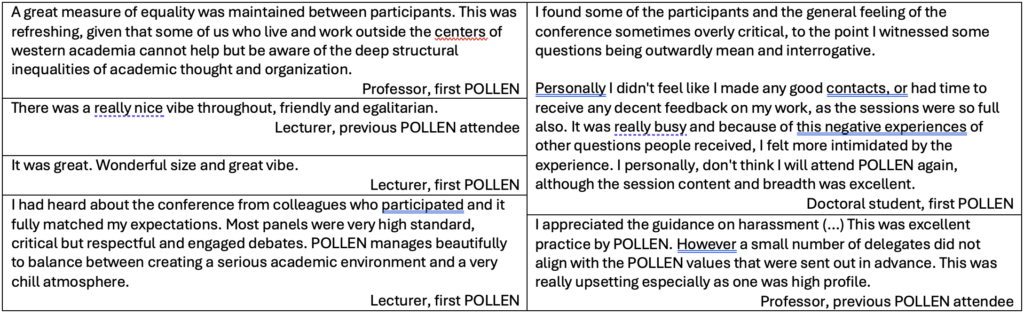
Such intentionality and care needs to be nurtured in POLLEN. There were many respondents who thoroughly appreciated the ‘good vibe’ and atmosphere at the conference. But there were exceptions to this positive experience. The guidelines we issued covering good contact were not always followed. The contrasting experiences are illustrated below.
Finally, a number of people commented on the fact that POLLEN risks becoming too academic and that we need more engage work and connection with civil society and activist organisations. This is always an important aspect of POLLEN, but once again there is a diversity of views on the issue, as shown below.
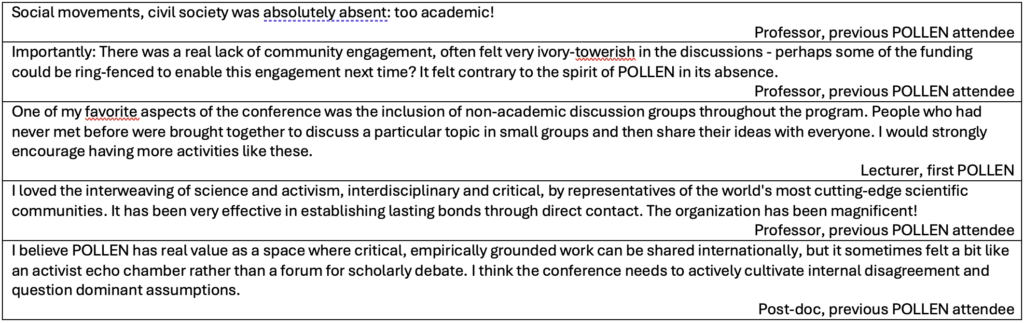
In the main people wanted more activist engagement, but I would also caution about how this works out in practice. We were keen in POLLEN 2026 to ensure that the engagements came on terms that civil society and activist colleagues wanted – and not because visiting delegates expected it. We anticipate there will be a different complexion to the collaborations in the next POLLEN.
The feedback covered far more issues than can be covered in a short blog like this, please do check out the complete report (here) to explore them. Once again my thanks to everyone, especially Maria, Alix, Camilla, the scientifici and local organising committees and NomadIT for making all the good things possible and to the hundreds of delegates whose feedback makes this sort of learning possible.
Dan Brockington
Barcelona Sept 2026