Essential Oils and Essential Work: The Labor Behind Pandemic Wellness Commodities
Chanelle Adams writes about the relationships between essential oils and essential work, under a political ecology lens and in the context of Madagascar.
By Chanelle Adams
Essential work
“Indispensable labor for maintaining life and health during crisis.” – (International Labour Organization 2023)
Essential oil
“A volatile part of a natural product obtained by distillation or expression. The oil is ‘essential’ in the sense that it carries the distinctive scent, or essence, of the plant.” – (European Chemicals Agency)
Early in the pandemic, the plant ravintsara (“good leaf” in Malagasy, known to botanists as Cinnamomum camphora) caught my attention. After more than a decade of researching the production and circulation Malagasy plant medicine and knowledge, this was the first time I had seen a Malagasy plant promoted for widespread use abroad.
Ravintsara’s glossy leaves have been used in Madagascar for over a century to recover from respiratory illness and fatigue, most commonly through steam inhalation (called evoka). During the pandemic, however, ravintsara surged in international popularity in a different form: an essential oil. Drops of the tree’s essence found their way into diffusers, pharmacies, wellness kits, and “natural immunity” routines in homes, offices, and yoga studios around the world, especially in the pre-vaccine phase of the pandemic.
What went largely unremarked, however, was the labor required to meet the sudden demand for turning leaves into oil.
During the pandemic, the word “essential” took on new weight. It became a modifier that shaped who moved during lockdowns, who faced risk, and whose labor was recognized as necessary for the benefit of others. In its narrowest sense, essential work was attached to hospitals, care homes, and food service. The imagination of essential work often stopped at the point of service, leaving workers far upstream in supply chains outside consumer imaginaries and public recognition.
Before the pandemic, however, the most familiar modifier for “essential” had been “oil.” What began as a play on words in a research proposal––essential labor and essential oil––became an argument once I returned to the field in Madagascar’s Central Highlands. As I describe in my recent article for CAFE, essential oils are not remarkable for their chemistry alone, but for the labor and expertise required to extract them.
When wellness becomes opportunity
National Road 7, known as RN7, cuts across Madagascar’s highland plateaus from the capital of Antananarivo to Tulear at the south west of the country. It is a major artery of circulation for people, animals, plants, and materials. The road is a living corridor of craft, aspiration, and for those who are both lucky and industrious, opportunity.
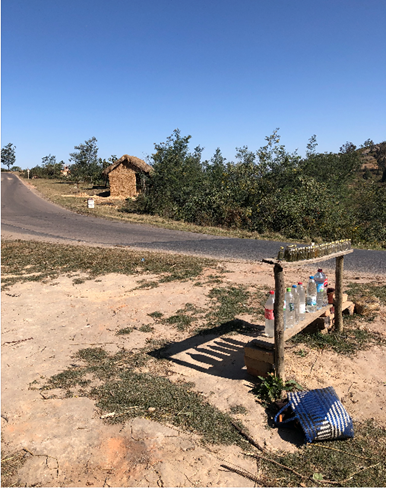
Along its bends and valleys, villages often offer a single specialty. Aluminum pots hammered from scrap. Neat pyramids of carrots. Wild silk scarves and lamba, fresh pressed paper, bricks laid out to dry like loaves of clay bread. This is the land of voandalana, fruit of the road. While the term refers to travelers bringing seasonal fruit home from afar, along RN7, it has expanded to include the fruits of roadside labor itself.
Even the air registers this industrious economy. Depending on season and hour, the wind carries notes of firewood, rice, mud, and swidden fields. During the pandemic, radio broadcasts, Facebook posts, and neighborhood gossip repeated the same claim: Madagascar had found the COVID-19 cure. Not only would Malagasy people need ravintsara in abundance, they were poised to supply it to the world (I have written more about this here). As demand and prices soared, the air from Antananarivo to Fianarantsoa filled with the sharp, camphorous scent of ravintsara leaves being distilled into oil.
Who benefits from natural healing?
My research turns upstream of export, and downstream of tree planting, to focus on the workers in the ravintsara economy who labored intensively to supply global markets with plant-based antivirals by turning leaves into oil. This commodity does not leave Madagascar as raw material. It is processed on the island, and therefore the expertise, labor, and resources that make ravintsara oil extraction possible are visible where it is produced.
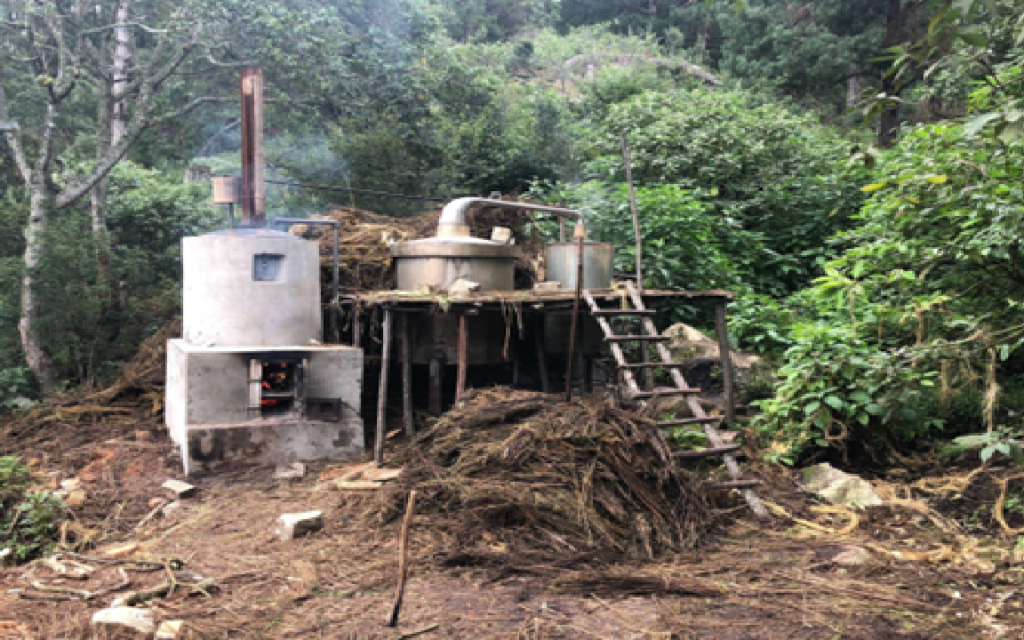
Madagascar exported over 50 tons of ravintsara oil in 2020. The scale of production sits uneasily with the smallness of the informal sites where the oil is made and with the resources required to extract it. Roughly 300 kilos of leaves yield about 3 kilos of oil after hours of steam hydrodistillation, using water, firewood, and constant attention. Production is slow, labor intensive, and dependent on careful judgment based on practice and experience.
In Madagascar alone, an estimated half a million families depend directly or indirectly on the largely informal essential oil sector, with livelihoods riding behind each liter of oil produced. Leaf collectors are paid by the kilogram, picking and hauling fresh leaves by hand. Distillers, known as mpitanika ravina, sleep beside their stills to keep firewood- fueled boilers running, adjusting heat and timing to avoid burning leaves or degrading quality. Still builders fabricate and repair equipment from old barrels, pipes, and scrap metal, patching leaks and keeping production going when demand surges. Buyers speed along the road. Middlemen load sacks of leaves into trucks, deliver them to distillation sites, and return hours later to move oil toward the capital and export markets. Together, unevenly, these workers absorb the risks and opportunities of expanding wellness markets so that alternative health commodities can circulate elsewhere as something marketed as pure, clean, and natural.
The cycles of global wellness markets rarely align with the long-term financial needs of workers. A few essential oil producers were well positioned and made significant profits in 2020, but for most, the story follows a familiar boom-and-bust rhythm. If political ecology takes seriously the labor, resources, and power relations embedded in global markets, it must also take seriously the rise of wellness commodities and alternative medicines, now a multi-billion-dollar industry. These markets rely on informal, skilled, and place-based labor that rarely registers as essential, even when, as in the case of ravintsara, it sustains supply for global regimes of care during crisis.
Ravintsara invites us to look closely at the small and the scented. Essential oils may seem marginal, but they are everywhere, not only in aromatherapy but in soaps, shampoos, detergents, perfumes, and cleaning products. Behind each drop are ripple effects that shape land use, organize labor, and sustain livelihoods across Madagascar’s highlands, even as these economies remain overshadowed by more visible commodities like food crops, minerals, and energy.
Acknowledgements: This research was made possible through the generosity of essential oil workers in Madagascar who shared their time and insights. I am especially grateful to Moussa Aly and Fanja Ralaindratsiry for their orienting introductions to, and guidance navigating, the distillation landscape. I would also like to thank Christian Kull, Ben Neimark, and Priya Rangan, as well as the special issue editor Megan Styles and the anonymous reviewers, for their critical engagement and insightful suggestions that greatly strengthened this research.