From hosts to hostages: how colonialism is turning our seas into graveyards of humanity
The Mediterranean, Palestine, and the Intersection between Ecocide and Genocide
By Rebecca Borges
The seas were once feared, but coastal waters and the high seas have also been navigated by human populations for fishing, trade routes, and distant exploration. The seas were respected, and still are by traditional and Indigenous peoples who struggle to preserve their stewardship over waters—communities that view oceans and rivers as mighty beings, gods, or family members deserving reverence. The seas were always a mighty host, who would welcome, sometimes less friendly so, its human guests.
Centuries ago, the seas became unwilling hosts to the routes where vessels would travel from Europe to colonized, “uncivilized” lands. Serving as instruments for colonization, the seas themselves, and not only were these far-away lands, being colonized. The Atlantic, for example, became the graveyard of thousands of enslaved people who were thrown overboard after dying on slave ships, even changing shark migration patterns in the region. At around the same time, the Mediterranean Sea, including cities like Venice, is believed to be the birthplace of capitalism, with blooming trade cities and markets.
The seas have been, for the last few centuries, slowly turned into hostages of the colonial venture that gave birth to capitalism, a means of navigation for the transport of “goods” whose extraction and sale gave space to not much good, really. Just like the seas, Palestinians have been turned into the hostages of the modern-day colonial enterprise known as “israel”, an enterprise of colonial extraction and imperial warfare (Figure 1).
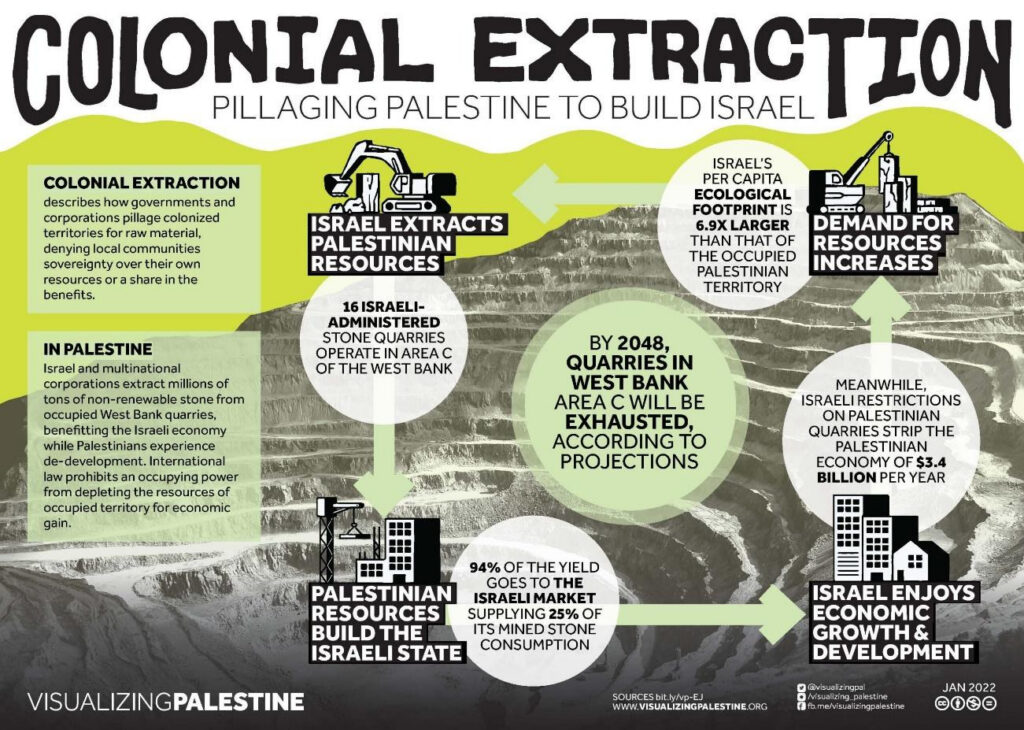
Figure 1. Land-based colonial extraction by Israel in Palestine, by Visualizing Palestine (reproduced under a Creative Commons license CC BY-NC-ND).
Just as israel holds Palestinian land and Palestinian bodies hostage, it now claims part of the Mediterranean Sea as well. When the Freedom Flotilla sailed from Barcelona in August 2025, aiming to break the israeli siege by reaching Gaza’s coastal waters, crew members were intercepted and detained. Israel claims an “exclusion zone” extending 150 nautical miles off Gaza [1] and allows itself to capture boats stating that it is necessary to prevent weapons smuggling, a discourse similar to the recent United States’ rhetoric on drugs smuggling in the Caribbean [2].
Genocide + Ecocide = The Destruction of the Earth
The blockade of Gaza itself drives grave ecological destruction beyond human devastation. Without cooking gas entering the strip, Gazans have resorted to using timber for firewood, felling the few remaining trees in the strip [3]. Locals report with sorrow: “Some had been cut down for firewood. The rest had fallen prey to Israel’s bulldozers” [3]. Even amid famine and bombardment, Palestinians grieve their trees: “They sent me a picture of how the building looks without my trees. It is empty and dark. I felt like they took my soul” [3].
Colonization also takes the Mediterranean Sea hostage through land-based activities. Israel has destroyed or damaged all five of Gaza’s wastewater treatment facilities, contaminating beaches, coastal waters, soils, and potentially groundwater, according to a UN environmental assessment [4]. Untreated sewage pollutes the marine environment and coastal habitats, harming Gaza’s fishing industry—fish being a key food source and fishing a traditional vocation where food insecurity and unemployment are catastrophically high [4].
The Wadi Gaza wetlands, an internationally important refuge for migratory birds where ecological restoration was underway before October 2023, have been damaged by military operations and pollution. Between 25 and 50 percent of Wadi Gaza is believed to be destroyed as of June 2024, along with the ecosystem services it provides [5]. Beyond direct destruction, carbon emissions from israel’s actions in Gaza contribute to climate change, extreme weather events, rising sea levels, and harmful effects on ecosystems and human health [6, 7]. Adding to the countless breaches of international law related to human rights, israel’s military actions have likely breached several legally binding international environmental treaties it has committed to, including the Paris Agreement, the Convention on Biological Diversity, and the Mediterranean Action Plan under the Barcelona Convention [4].
According to Andreas Malm, there is an articulation between the destruction of Palestine and the destruction of the Earth — points where one process impacts and forms the other in reciprocating causation [8]. In the context of the long history of fossil capital, the genocide in Gaza is not accidental. The destruction of Palestine and the destruction of the Earth play out in broad daylight with abundant documentation of both processes unfolding in real time. Yet the capitalist core keeps rushing fuel to the fighter jets and bombs to Gaza. Destruction and construction are interpenetrating opposites: the destruction of the planet is the construction of fossil fuel infrastructure; the destruction of Palestine is part of the (re)construction of racial colonies [8]. Ecocide fuses with genocide in a manner perhaps never seen before.
The seas now experience a new wave of instrumentalization in genocide, being made hostage to the re-surfaced western colonial enterprise. The peoples of the world, however, are changing the tides: the flotillas sail on with the goal to contribute to a free Palestine but also to release the Mediterranean from the rule of IDF, Frontex, and the like. With its 2.5 million square kilometers (half the size of the EU), there is a lot of water to cover, and the boats are few and small. However, the peoples of the world remain strong and faithful in the struggle for a free land, with the river and with the sea – Palestine, its lands and its waters, will be free.
Acknowledgement and Disclaimer
The author thanks the Marine Political Ecology collective (https://marinepoliticalecology.net/), especially Dr. Merdeka Saputra, for initial discussion on this topic. However, the author takes sole responsibility for the content of this manuscript, as the collective was not involved in the actual writing of this piece.