Joana Sá Couto – Listening by the Sea: becoming an Anthropologist
.
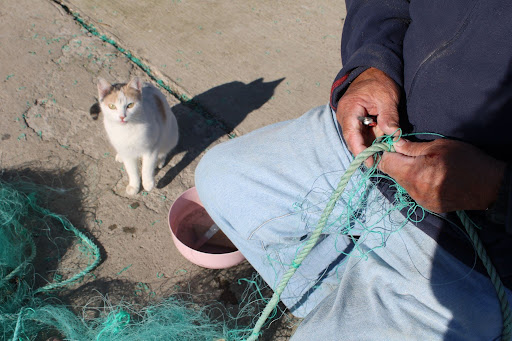
Image: A cat watches me and my camera as I talk to a fisher in Sesimbra in the winter sun.
My work as an anthropologist has been focusing on the relationships between humans and the ocean, particularly in the maritime context. My academic path began with an early interest in social dimensions of climate change, after a seminar on environmental anthropology. During my undergraduate studies, a great teacher gave me a book that changed my path: O Mar é que Manda by Paulo Mendes (later edited in English by Berghan Books as The Sea Commands). Mendes’ study of fishers and climate change captivated me for its ability to connect global issues with the everyday lives of local communities, addressing pressures from tourism, economics, and climate alike.
Ten years later, I am a proud anthropologist with a PhD in Climate Change and Sustainable Development Policies. I’ve spent long days handling nets, nights on boats, walking along fishing docks, and learning to listen closely to people whose lives depend on the sea. My journey was not easy: I grew up in a coastal town but had no personal ties to the fishing sector. Through luck, humour, persistence, and humility, I found my place in the male-dominated world of maritime life by being eager to learn and to listen. Over time, I even learned to talk, eat, and cook like the communities I was immersed in, to the amusement of my family, as my accent shifted a bit in words and enunciation.
During my master’s, this immersion made me realise that I wanted to pursue maritime anthropology further. For my doctoral work, I spent extensive time with fishers in Setúbal and Sesimbra. I learned that research is not just about notebooks and theories (although I love those). It is about trust, mutual support, and shared experiences. My PhD focused on the ecologies of labour in fisheries, where I mobilised the concept of labour as a mediator of the relationships between humans and nature, showing how fishing constitutes a form of ecological labour profoundly transformed by climate change and capitalist commodification. This also allowed me to explore issues of justice, blue grabbing and marginalization, and migrant labour in Portuguese fisheries, bridging ethnography with broader social and ecological theories. This thesis also deepened my radical commitment, strengthening my belief in community-led resource management and motivating me to engage with justice both inside and beyond academia.
In short: I study the ocean, the people who live from it, and how their knowledge can shape a fairer, more sustainable world. Real understanding happens where notebooks meet real lives, in conversations on docks, shared laughs, and over meals telling stories that may not fit conventional academic molds.My work is about creating connections, crossing disciplinary and social boundaries, and turning knowledge into action. I believe knowledge should move across communities, across disciplines, and into imagining and creating a better world. In this spirit, I also coordinate a seminar series within a network I co-founded on Ecologies of Labour, which you are welcome to join and engage with – we would love to have you.
Joana Sá Couto, Institute of Social Sciences, University of Lisbon/Portuguese Institute for the Sea and Atmosphere