35 Apps and Counting: Mapping Bihar’s Digital Agriculture Experiment
Inside the fragmented landscape of climate-smart agriculture technology
By Vidya Pancholi, Lancaster Environment Centre, Lancaster University
R Kumari, a Skilled Extension Worker with Jeevika in Vaishali district, pulled out her smartphone during our October 2024 conversation. ‘We have uploaded a chatbot to their phone,’ she explained, referring to the farmers in her network. ‘We have shown videos to them. We have shown videos on paryavaran [environment].’ Her phone contained at least four different
agricultural applications: Digital Green’s video platform, a weather forecasting app, the IFFCO-
KISAN advisory service, and a nascent AI chatbot being piloted in her block. When I asked
which farmers actually used these apps regularly, she paused. ‘Some of us are affiliated with
Jeevika,’ she said carefully, gesturing to her colleague. The implication was clear: the apps lived
primarily on extension workers’ phones, not farmers’.
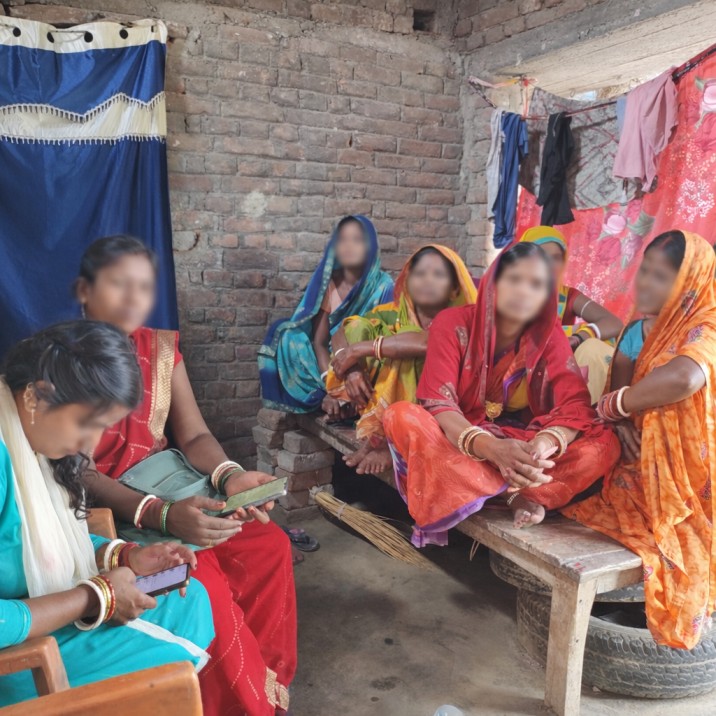
Figure 1: A picture of a focus group discussion in Vaishali, Bihar, where the extension workers show enthusiastically the apps they use (source: author’s own, with consent from the farmers and extension agents)
This scene captures a defining feature of Bihar’s digital agriculture landscape: a proliferation of technological interventions that exceeds the agrarian system’s absorptive capacity. Over the past decade, Bihar has become what development professionals describe as a ‘laboratory’ for digital climate adaptation. More than 35 mobile applications, AI-powered chatbots, geospatial platforms, and data integration systems promise to revolutionise how Bihar’s 13 million farming households adapt to climate change. Yet ten months of ethnographic fieldwork revealed a profound gap between this technological abundance and agrarian reality.
A Fragmented Landscape
The 56 interviews and 22 focus group discussions, conducted between November 2023 and January 2025, revealed not a coherent system but a fragmented assemblage of overlapping, competing, and often incompatible platforms. These interventions cluster into five broad categories, each with distinct technological architectures, funding models, and target users, as presented in Table 1. This categorisation reveals the first critical insight: the promise of digital integration remains largely unfulfilled. Technological interventions operate largely in silos. Registration processes are duplicated. Data collected by one system remains inaccessible to another.
| Category | Key Platforms | Function | Technology |
| Advisory Services | Digital Green, IFFCO-KISAN, Cropin | Crop advisories, pest management | AI chatbots, video platforms |
| Weather & Climate | Skymet, Mausam Bihar, IMD apps | Weather forecasts, rainfall alerts | Satellite data, weather stations |
| Market Linkages | DeHaat, BigHaat, IFFCO Bazar | Input procurement, price discovery | Marketplace platforms, e-commerce |
| Data Infrastructure | AgriStack, BIHAN, IDFS | Farmer registries, data integration | APIs, Digital Public Infrastructure |
| Financial Services | Gram Cover, PM-KISAN, DBT | Insurance, subsidies, payments | Fintech, parametric insurance |
| Pest Management | AgroStar, Plantix | Pest and disease detection | AI-enabled image identification |
Table 1: Classification of digital interventions in Bihar (Source: Fieldwork data, 2023–2025)
Time-bound pilot projects instead of long-term investments
A funding flow analysis of Bihar’s digital agriculture landscape, as mapped in Table 2, shows that most digital interventions originate from time-bound pilot projects funded by international donors, climate funds, philanthropic foundations, or private venture capital. This financing structure profoundly shapes what is built, for whom, and to what extent it is sustainable.
| Initiative | Funding Source | Status |
| SLACC (Sustainable Livelihoods and Adaptation to Climate Change) | World Bank + Dept of Rural Development + Cropin + Skymet | Pilot, launched between 2016 and 2018 |
| FRAME (Fostering Resilience in Agriculture through MRV Experimentation), Zero Tillage Potato, Farmer.chat | Digital Green + Sequoia Climate Fund + International Potato Center + GIZ | Pilot phase in Gaya and Vaishali |
| Index-Based Flood Insurance | International Water Management Institute IWMI, through ICAR-RCER | Pilot, launched between 2018-2020 |
| Mausam Bihar | Bihar Government | Active, limited reach |
| DeHaat, AgroStar, BigHaat | Venture capital, private equity | Commercial operations, variable rural penetration |
| Integrated Digital Farmer Services Platform- IDFS | Bill & Melinda Gates Foundation + Bihar Government | Consolidation attempt, transitioning to govt ownership |
| VISTAAR -Virtually Integrated System To Access Agricultural Resources | Department of Agriculture & Farmers Welfare, Government of India | In various stages of preparation |
Table 2: Funding flows across digital interventions in Bihar
Farmers participating in the SLACC project expressed experience with the pilot nature of the project in the following way. ‘When SLACC came, it took one year even to understand what it is. In the second year, we received training in organic farming. Subsequently, we visited the villages to provide training. And after that project got over’ (FGD, Tetaria, 10 January 2025). A three-year timeline provided one year of understanding, one year of training, and then terminated before practices could be embedded. Farmers invest labour in understanding platforms and disseminating innovations, only to see projects terminate once donor funding cycles have ended.
The Adoption Gap
Perhaps the most striking finding from fieldwork was the yawning gap between technological availability and actual adoption. Across several in-depth farmer interviews and FGDs, only a handful of farmers regularly used any agricultural app beyond basic weather forecasting. The concrete barriers underlying the adoption gap are summarised in Table 3.
| Challenge | Evidence |
| Multiple Registration | Separate registration for each platform despite integration promises |
| Literacy and Language | Text-heavy interfaces exclude semi-literate farmers; voice chatbots require connectivity |
| Gendered Access | Women access apps through husbands, sons, or extension workers |
| Connectivity | Patchy rural internet; data costs are prohibitive for daily use |
| Trust and Accountability | No grievance redressal when advice fails |
| Pilot Dependency | Platforms disappear when donor funding ends |
Table 3: Challenges facing farmers in Bihar’s digital agriculture landscape (Source: Fieldwork data, 2023–2025)
Consider the selective appropriation described by one farmer from Kushahar, Vaishali. She used a weather app strategically: ‘The weather app said that from the following Thursday, it would start raining. So, we did not irrigate our field. And when it rained, I just used urea afterwards.’ Yet the same farmer relied primarily on Jeevika extension workers for pest management advice, on collective experimentation with new crop varieties, and on peer networks for market information.
‘We do not want their crops to get damaged. This can even affect our dal-roti [daily food]. So we test innovations on small parcels before wider adoption.’ This reveals the stakes underlying technological adoption decisions. For subsistence farmers, digital advisory is not simply about efficiency gains but about existential risk. Collective experimentation through Self-Help Groups enables risk distribution that individual app-mediated advice cannot provide.
What Actually Works: Jeevika as Alternative Infrastructure
Paradoxically, the most effective agricultural knowledge system I encountered was not a mobile application at all, but rather Jeevika, Bihar’s state rural livelihoods programme, which operates through Self-Help Groups. Figure 2 below illustrates this finding, challenging the dominant narratives that position digital technology as inherently superior to ‘traditional’ extension.
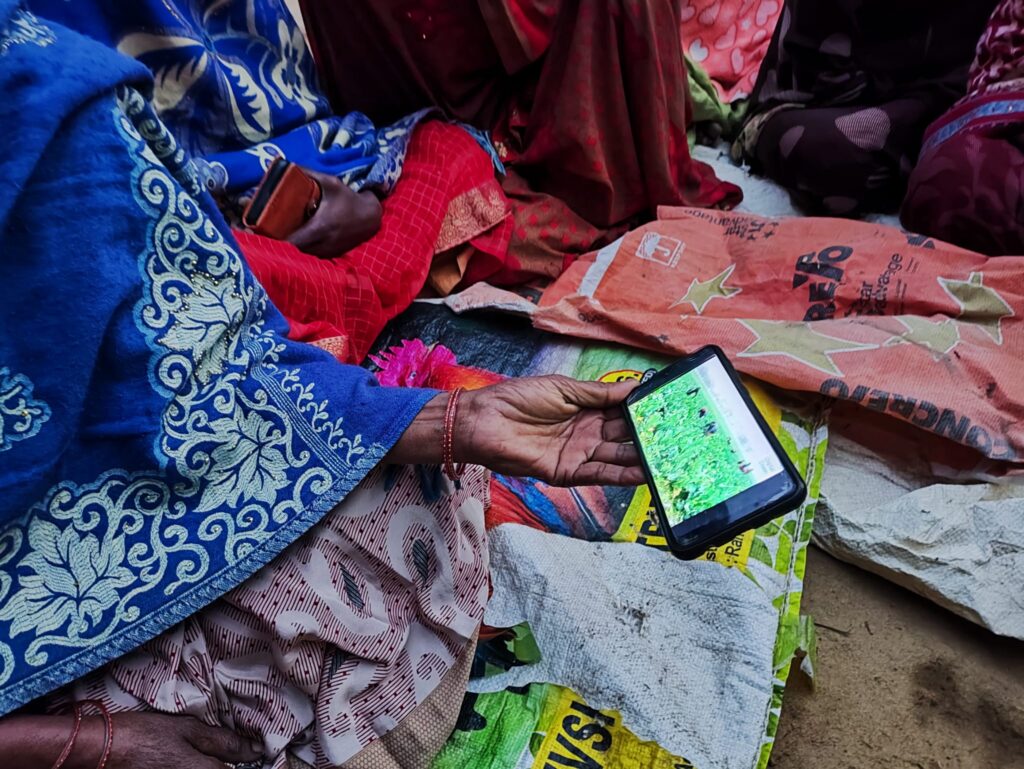
Figure 2: A Jeevika extension worker showing other farmers at an SHG meeting, a video on Systematic Rice Intensification (Source: Author’s own, 2023, with consent from the farmers)
Jeevika operates through a multi-tiered architecture. Anjali, an extension worker in Mahua, Vaishali, explained, ‘Right now, I am looking after two VOs [Village Organisations]. We have 15 groups [SHGs] within a single VO. This means I am looking after 30 groups. Each group comprises 10-15 farmers. That means I have a target of 300-450 farmers.’ (Interview, Vaishali, 05 December 2024). The Jeevika extension workers, unlike other state government extension services, are embedded in communities and operate through face-to-face relationships and collective deliberation.
This relational infrastructure enables what algorithmic platforms cannot: context-specific advice responsive to local soil conditions and microclimatic variations; collective experimentation that distributes risk across peer networks; and in-person interaction allowing clarifying questions and iterative learning. Anjali further commented: ‘One does connect with 10, 20, 30 people within Jeevika. They get opportunities to talk to each other. And when they start talking, they do start knowing about essential information related to farming’ (Interview, Anjali, Vaishali, 05 December 2024). Critically, Jeevika increasingly mediates farmers’ engagement with digital platforms. Extension workers download apps, filter relevant information, demonstrate technologies at SHG meetings, and aggregate demand for inputs or services. In this hybrid model, digital platforms augment rather than replace relational knowledge systems.
Implications: Rethinking digital agriculture
Bihar’s experience reveals three important insights that hold crucial lessons for digital adaptation beyond South Asia. First, technological proliferation should not be confused with innovation. The abundance of platforms reflects funding structures that incentivise novelty over sustainability, pilot projects over institutional integration, and technological solutions over systemic transformation. Second, adoption metrics require critical scrutiny. Downloaded applications do not translate to daily use; trained users do not necessarily transform practices; technological availability does not ensure accessibility. Third, and perhaps most importantly, digital platforms work best when embedded within social institutions that provide context, mediation, and accountability. The future of digital agriculture, therefore, hinges crucially upon augmenting relational knowledge systems.
As climate change intensifies pressures on Bihar’s agriculture, digital technologies will undoubtedly play important roles. The question that Bihar faces, however, is whether the next wave of digital climate interventions learn from the fragmentation of the past or reproduces it at ever-greater scale.
This blog draws on ten months of ethnographic fieldwork (November 2023 to January 2025) across Bihar’s Vaishali and Gaya districts, involving 56 interviews and 22 focus group discussions with farmers, extension workers, bureaucrats, and development professionals. This work forms part of the Digital Climate Futures Project, which examines digital technologies in climate adaptation governance through decolonial and justice frameworks. The research received ethical approval from Lancaster University’s Research Ethics Committee. All procedures complied with the UK Data Protection Act (2018) and GDPR.
Vidya Pancholi is a Senior Researcher at Lancaster Environment Centre, Lancaster University, currently working on the Leverhulme Trust-funded Digital Climate Futures Project. His research examines how digital technologies operate in climate adaptation governance across rural Bihar, India, using frameworks of political ecology, climate coloniality, and digital coloniality. By examining resistance practices against algorithmic exclusion, his research aims to centre marginalised voices in climate adaptation.