Mira Käkönen: water, power and infrastructural transformations in Southeast Asia
.
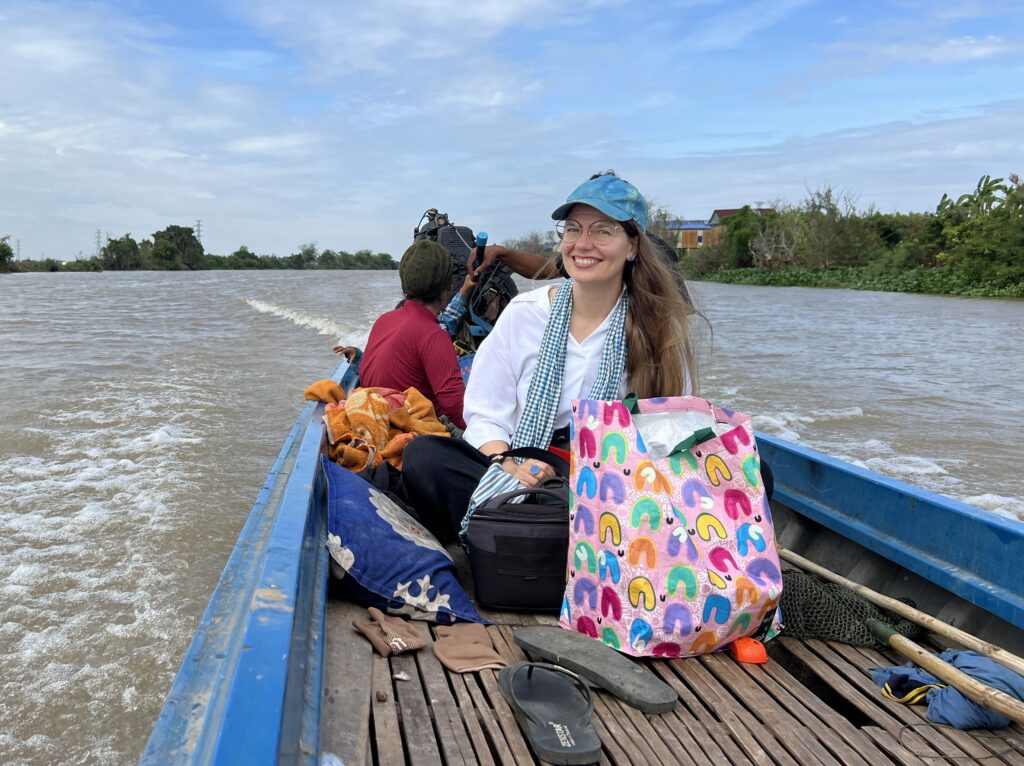
Image: Fieldwork in December 2025, Takeo Province, Cambodia (Photo by Vutha Srey)
My name is Mira Käkönen and I am currently an ARC DECRA Fellow at the Australian National University. Over the past years, my work has explored the politics of environment and development, with a particular focus on how water resources are made and governed in the Mekong Region of Southeast Asia. Much of my research has examined how hydropower expansion, climate interventions, and state- and corporate-led infrastructural projects converge in ways that profoundly reshape rivers and the lives of riverine communities (e.g. Käkönen and Nygren 2023).
My current DECRA project, Volatile Rivers and the Infrastructure Politics in the Mekong Region, continues this trajectory. The project investigates the shifting entanglements of rivers, infrastructure, and power relations, as well as how these are increasingly shaped by a globalizing China and accelerating climate change. Through this work, I try and shed new light on how the rapid acceleration of hydraulic infrastructure building and intensifying climate change co-produce what I call ‘violent fluvial volatilities’ that generate new forms and temporalities of infrastructural harm.
I am also part of the research project ‘Repair and responsibility in ruined environments of the global South’, led by University of Helsinki, which examines the emerging political ecologies of repair and the ways in which people living on the extractive frontlines reimagine and remake their livelihoods.
Moreover, I conduct ongoing research on the role of knowledge infrastructures in contemporary environmental governance schemes, such as carbon offsetting. I recently also contributed to a collaborative effort to rethink the role of environmental assessment amid regulatory rollbacks and how to move from past failures toward relational and cumulative assessments (and effective environmental regulation) that better accounts for complex processes generating differentiated vulnerabilities while drawing more justly and comprehensively on Indigenous and other forms of local (situated) knowledge.
Political ecology has long felt like an important intellectual home for me. The POLLEN community, and especially its conferences, have been inspiring with fruitful encounters and discussions that have pushed me to think about environmental politics and justice struggles in new ways. I have also worked to ‘cross‑pollinate’ political ecology with resonant fields. For instance, I have worked to bridge political‑ecological research on resource frontiers with STS‑influenced infrastructure studies and with geographical work on enclaved spaces of governing. This led me to develop the concept of ‘overlapping zones of exclusion’, which helps illuminate how multiple regimes of resource control may converge in consequential yet under‑recognized ways in frontier sites. It also led me to work on the idea of ‘entangled enclaves’ to capture how Chinese dam projects in Cambodia exhibit both disconnections and connections with the surrounding society and environment, shaping new political‑ecological relations as well as socio‑spatial formations.
My forthcoming POLLEN presentation (with my co-authors) draws from one of the case studies in my current DECRA project: a major China supported canal project in Cambodia. I examine its striking combination of spectacle, opacity, and uncertainty to show how the project has already, before it is even being built, generated a range of (geo-)political and (geo-)economic effects including uneven gains and losses on the ground. Drawing on political ecology as well as debates on infrastructure and anticipation, I am developing a relational approach to analysing consequential anticipatory hopes and anxieties, tracing how these emerge through shifting and multiscalar (dis)connections between geopolitical, sovereign, and grounded project-adjacent power dynamics.