Questioning quails: An experiment in interspecies decision-making
By Cebuan Bliss, PhD, Founder of TIDE - The Transformative Interspecies Democracies Centre
How can we include non-human entities in our governance practices? That is the central issue of this blog and one which is gaining traction in scholarly literature and some transformative policy rhetoric. Attributing rights to nature is now an established means to represent and protect natural entities. Furthermore, different perspectives on non-human participation and representation are emerging, including having humans as proxy representatives, or using AI to ‘listen’ to the voices of animals directly. Such transformative governance practices are an essential element of multispecies justice, and of moving towards societies of interspecies cooperation and flourishing.
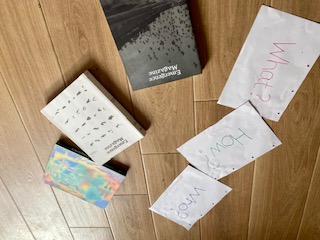
When thinking about interspecies governance, these inter-related questions come to mind:
Who? Which other beings do we need to represent? Which humans do we need to influence/bring in as stakeholders?
What? On what issues is it important to represent more-than-human interests?
How? How do we represent these other beings?
Workshop discussion prompts
Despite increased scholarly engagement with the topic, there are still few empirical examples of multispecies participation and representation. Therefore, there is a need for moving from theory into practice – the ‘how’ question. Animal sanctuaries are places where we can begin to answer this question by experimenting with new methods of political inclusion. Taking inspiration from interspecies councils and multispecies citizens assemblies, I experimented with a multispecies deliberations workshop at Quinta das Águias animal sanctuary in Portugal, where I was volunteering. In the next sections I summarise the experiment and reflect on lessons learned for multispecies representation.
Questioning quails
In November 2025, a group of 7 humans and a cast of more-than-human beings came together for a collaborative multispecies deliberations workshop. All of the humans participating had a particular interest in animal and/or environmental justice. The purpose of the workshop was to design and implement a multispecies deliberation process. We experimented with structures of multispecies participation, listening, and decision-making with these questions in mind (given to participants before the workshop):
- How can we meaningfully represent nonhuman interests?
- What practices of listening and attention make this possible?
- How could practices of multispecies representation transform our understanding of democracy and justice?
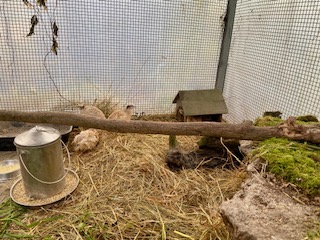
Together, the group decided to use a process of multispecies deliberation to design new accommodation for the 7 quails, who currently live in a small, metal enclosure on one of the main walking paths around the sanctuary.
Attunement
We started the day with an attunement exercise; widening our senses and perceptions to the lifeworlds of other animals. To do this, we spent time with the sanctuary chickens and turkey in a large, forested outdoor enclosure. We observed their behaviour and were encouraged to sense their non-verbal communication. Through silence, slowing down and directed attention, the group began to notice the subtle sounds, sights and feelings of chicken communication.
The deliberations
After our attunement, we turned our attention to the quails and their new home. Whilst spending time with the quails to ‘hear’ their input, we identified key stakeholders in this process:
- Quails
- Care-givers (sanctuary volunteers)
- Visitors to the sanctuary
- Financers and sanctuary owners
- Free-roaming cats who live at the sanctuary
- Bees and insects living near the quails
- The land
- Physical structures
For the next stage, we separated into two groups. One group used intuitive interspecies communication techniques to communicate with the quails directly, based on a set of questions we had designed, to ask their opinions on what they would like in a new home. The second group undertook internet research on the behaviour of quails and their habitat preferences.
Interestingly, despite the quail communicators having no prior knowledge about quails, they presented information from their conversations with the quails which was corroborated by the research group. Together, we then discussed some practical options for the new accommodation, including size, materials and natural foliage. With this in mind, we visited two possible alternative locations in the sanctuary for the quails’ new home. As this was a one-day workshop, afterwards I wrote up a plan for future next steps.
Ecocentric experimentation and courage
The quail deliberation experiment raised some doubts from participants about intuitive interspecies communication and whether it is genuinely possible. Participants suggested multiple and longer conversations with the quails would have improved the process. A lesson learned is that the paradigm shift required to believe that we can have meaningful dialogues with non-humans represents a great leap, even for the ecocentrically-minded participants of the workshop. This shift is unlikely to be such a gap for those who have grown up in indigenous traditions in which communicating with other earth beings is a normal part of life.
To remedy this lack of confidence in interspecies communication, there is a need for the normalisation of ecocentric education. Ecocentric education is particularly important for people who aren’t already ecocentrically minded. Animal sanctuaries can be places for such education; places of co-learning between humans and other earth beings. Sanctuaries offer spaces for real-world experimentation with non-human representation in order to inspire people and encourage political advocacy on behalf of non-human entities. As stated by one participant: “Being in a sanctuary was an amazing experience for me because I had the opportunity to truly engage with different species. That was something I did for the first time in my life.”
The practices at some sanctuaries like VINE in the USA already serve as examples of animal-inclusive decision-making. However, this is not the norm at most sanctuaries which, despite caring for animals in need, usually do not actively include them in decision-making. One reflection based on the quail deliberations and my time spent volunteering is that animal representatives should be appointed to the board of sanctuaries.
What all this takes is courage – courage to try out new methods of inclusion, the courage to believe that we can communicate with other animals and to speak up about it. Most experiments so far are at the local level, where people seem more willing to take risks and experiment with creative inclusion methods. What we need more of is experimenting at the other governance levels, including national, regional and transnational levels. Imagine if the next time the United Nations debated animal welfare, farmed animals were not spoken for but represented themselves as political subjects in their own right. Of course, experimenting with non-human representation will raise ethical questions, but without trying our interspecies relationships will not improve. Realising this vision demands a willingness to confront and dismantle the anthropocentric structures on which contemporary governance still rests. Those with the courage to do this are more likely to embrace the changes required to create flourishing multispecies communities. Having spent the last year working directly with our nonhuman kin, I believe that making a positive difference to life of even one is a worthwhile endeavour.
Acknowledgements
I would particularly like to thank the quails of Quinta das Águias, and the sanctuary itself for enabling me to host a workshop on multispecies deliberations. Thanks also to the participants of the workshop and other earth beings who were present.