Social-ecological conflicts: conceptualising other-than-humans as conflict parties
From actors to coalitions: advancing a social-ecological conflict perspective beyond anthropocentrism
By David Kuhn1 and Markus Rauchecker1,2
1Institute for Social-Ecological Research (ISOE), Frankfurt/Main, Germany
2 Senckenberg – Leibniz Institution for Biodiversity and Earth System Research, Frankfurt/Main, Germany
Environmental conflicts grow in number and intensity worldwide and so does concerned scholarship in Political Ecology. To broaden the dominant anthropocentric research perspective on environmental conflicts as social conflicts about nature, we recently proposed a conceptual approach to social-ecological conflicts with nature by bringing other-than-humans into the analysis. Our open access article has been published in Environment and Planning E: Nature and Space and can be accessed here.
We define social-ecological conflicts as “spatiotemporal encounters between two or more coalitions consisting of humans and other-than-humans and contributing to incompatible societal relations to nature” (Rauchecker, Kuhn et al., 2025: p. 8). Our concept invites conflict researchers in the field of political ecology to consider explicitly the active role of nature in conflicts by further developing terms from conflict research in such a way that they can be empirically applied to humans and other-than-humans including artefacts, biotic and abiotic natures alike:
Instead of actors we propose human and other-than-human conflict parties.
Instead of alliances we propose social-ecological coalitions consisting of humans and other-than-humans.
Instead of actions we propose effects.
Instead of motivations we propose impulses.
With the example of a water-related conflict in the Júcar river basin (Spain) we illustrate the analytical potential this conceptual shift holds for conflict researchers in Political Ecology.
The Júcar river basin in southeastern Spain covers large parts of the autonomous communities of Valencia and Castilla-La Mancha. While Valencian farmers use Júcar river water already for centuries, only in the 1970s Manchegan farmers around the city of Albacete introduced irrigated agriculture and intensive pumping from Mancha Oriental Aquifer on a large-scale. However, the aquifer also feeds the Júcar river flowing towards Valencia. Anthropocentric environmental conflict research analysed this conflict as upstream vs downstream competition over water resources between Valencian and Manchegan farmers. In contrast, a social-ecological conflict perspective highlights the decisive and various roles “other-than-humans” play in this conflict.
The hydraulic capacity (impulse) of the Júcar river with its falling flow volumes made visible the extensive groundwater use around Albacete and initiated the conflict in the first place in the 1990s (effect). Thereby, the river initiated and later reinforced the protests (effect) from Valencian farmers fearing the loss of their socio-economic and cultural heritage (impulse). Hence, a social-ecological coalition emerged.
In turn, the long-existing Tagus-Segura water transfer and the Alarcón reservoir with their capacity to collect and distribute water (impulse) created an opportunity for the Manchegan farmers to continue with intensive water use despite the Valencian protests by substituting groundwater with surface water (effect). Thereby, they form a coalition that enables the continuation of the modernist socio-economic development model in a peripheric region.
With a social-ecological conflict perspective, also a third social-ecological coalition becomes analytically visible. The Mancha Oriental Aquifer and ecological groups from both regions question the intensive irrigation practices both by Valencian and Manchegan farmers. For example, the aquifer’s varying depths (effect) combined with high energy prices in the past years limits groundwater pumping by farmers. Hydrogeological complexity (impulse) eludes absolute control over groundwater by demanding resource-intensive exploration, drilling and pumping. Also, washing out fertilisers (effects) due to large dissolvement capacities (impulse) which in turn limits the drinkability of groundwater in the region also signals the unsustainability of the dominant water use model upheld by Manchegan farmers.
Arguably, the Valencian and Manchegan farmers became strategic enemies in a sense. Instead of fundamentally changing their ways of living with and using water, both regions continue until today with intensive water use for agricultural purposes. Hence, the conflict was not about fundamental societal relations to nature but about distribution of the benefits. By the supposed resolution of the conflict by means of water storage and transfer infrastructure, remote sensing technologies for controlling water use or hydrological models defining minimum discharge of the aquifer into the river, the third social-ecological coalition that fundamentally questions the sustainability of irrigation both in Valencia and Mancha Oriental have been marginalised. A social-ecological conflict perspective reveals how the emergence and solution of a distribution conflict between Valencian and Manchegan social-ecological coalitions upheld an overall hegemonic hydraulic water regime in both regions but puts emphasis on a third coalition fundamentally questions these dominant societal relations to nature.
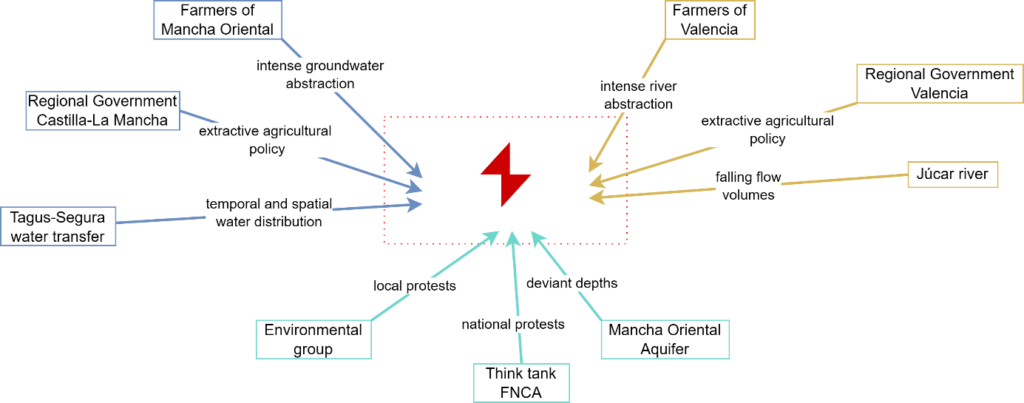
The following figure visualises the human and other-than-human conflict parties, their effects and subsequently the social-ecological coalitions in the water conflict in the Júcar river basin, Spain.
Font: Rauchecker, Kuhn et al. (2025, p. 17)
The different colours symbolise the different coalitions consisting of both human and other-than-human conflict parties (framed) that unfold reinforcing effects (arrows) that shape societal relations to nature in a particular time and space (rectangle in the middle with dotted frame lines). The lightning marks the incompatibility of societal relations to nature shaped by the different coalitions. Between the blue and light brown coalition, there is a confrontation because they both strive for water exploitation for the sake of socio-economic development at the same time and space. The turquoise coalition confronts with both blue and light brown because they strive for a fundamentally different way of living with river water and groundwater that does not seek to exploit them as resources for human development but respects their ecological integrity.
We hope that our contribution sparks empirical applications, theoretical critique and eventually further development. Therefore, we present our concept at the POLLEN conference 2026 in Barcelona (session “From alliances and coalitions to exclusions in environmental struggles?” P089) and are looking forward to critical and productive discussions!