We Are Not Weak: Resistance to Digital Coloniality in Bihar’s Climate Adaptation
Insights from ethnographic fieldwork across Bihar, India
By Vidya Pancholi, Lancaster Environment Centre, Lancaster University
On a December morning in 2024, over 200 women gathered outside the District Magistrate’s office in Muzaffarpur, Bihar. They carried paper flags, cooking stoves, and baskets. Their songs named the corrupt bureaucrats who denied them work under India’s Mahatma Gandhi National Rural Employment Guarantee Act (MNREGA): ‘Lahar lahar laharayi ho, jhanda majdoor bahan ka’ — the flag of the labourer sisters keeps waving. For over thirteen years, the Bihar MNREGA Watch (BMW) movement has organised such dharnas three to four times annually.
Two hundred kilometres south, in Gaya district, Meena, a Pashu Sakhi with Jeevika (Bihar’s Self-Help Group federation), acknowledged that digital technologies had changed farming practices — but insisted that meaningful adaptation moves through Jeevika’s relational networks, not algorithmic advisories (Interview, December 2024).
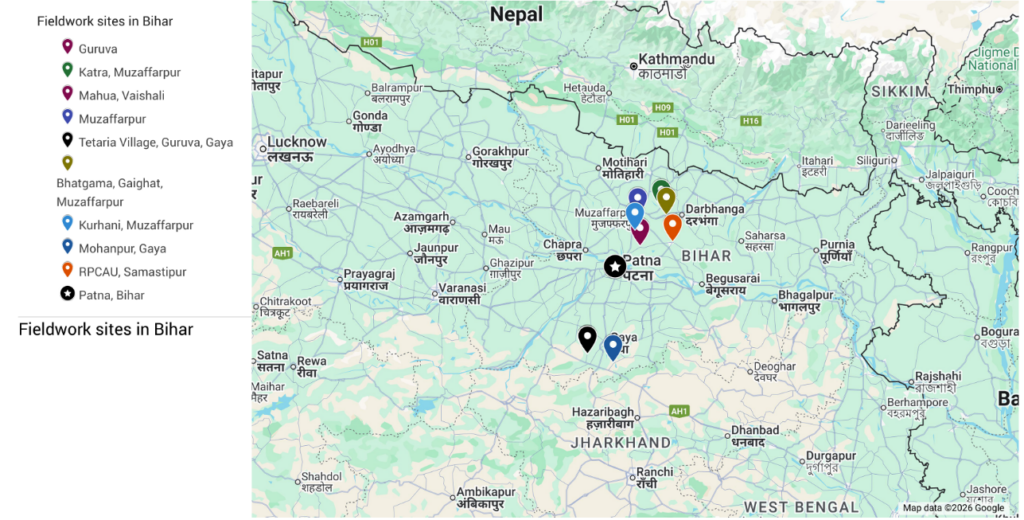
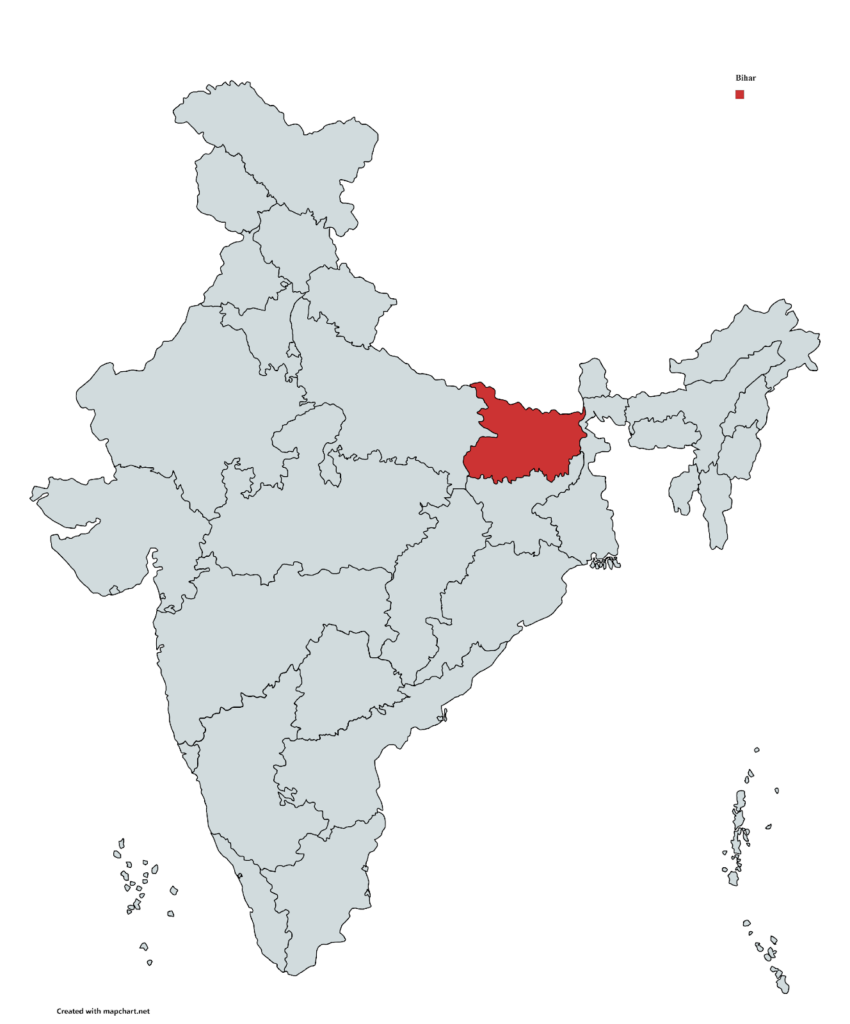
Figure 1: Research sites across Bihar (Source: Map data@2026 Google)
This blog examines resistance to digitalisation in climate adaptation within Bihar’s agriculture and wage work domains. It draws on ten months of ethnographic fieldwork between November 2023 and January 2025, covering Muzaffarpur, Vaishali, and Gaya districts. What registers as ‘failure to adopt’ often constitutes active refusal, revealing marginalised communities as politically sophisticated agents. The structural conditions against which these communities assert their agency are located within Couldry and Mejias’ (2019; 2024) framework of data colonialism and Mohamed et al.’s (2020) concept of algorithmic coloniality.
‘We Will Fight, We Will Win’: Resistance in MNREGA
MNREGA, the world’s largest social security scheme, has undergone rapid digitalisation. In response to systematic entitlement denial (Sharan, 2021), the BMW movement emerged around 2011 and now organises across 450 villages in three districts.
Counter-documentation is the movement’s most visible technological practice. Coordinators carry forms to villages, assist workers in completing applications, and collect block-office receipts — building an alternative data infrastructure that directly challenges flaws in official digital records (Interview, October 2025).
Strategic abandonment of digital platforms proved equally significant. In 2024, district officials created a WhatsApp group including BMW coordinators, attempting to channel complaints through digital mediation. Workers recognised the co-optative function quickly: minor grievances received attention; structural demands did not. The movement leader chose to exit the group and resume direct confrontation — a deliberate political calculation, not a retreat.
Cultural performance constitutes a third dimension. Songs and puppetry in Bihari dialects assert linguistic specificity against the homogenising logic of digital systems. One slogan directly confronts the conjunction of digitalisation and dispossession: ‘Na machine na thekedaar, rojgaar guarantee majdooron ka adhikar’ — no machines, no contractors, employment guarantee is workers’ right.
The spatial politics of protest constitutes the fourth dimension. Workers transform the protest site into a counter-space, bringing cooking stoves, cattle, and labour tools to create visceral proximity between digital abstraction and material reality.
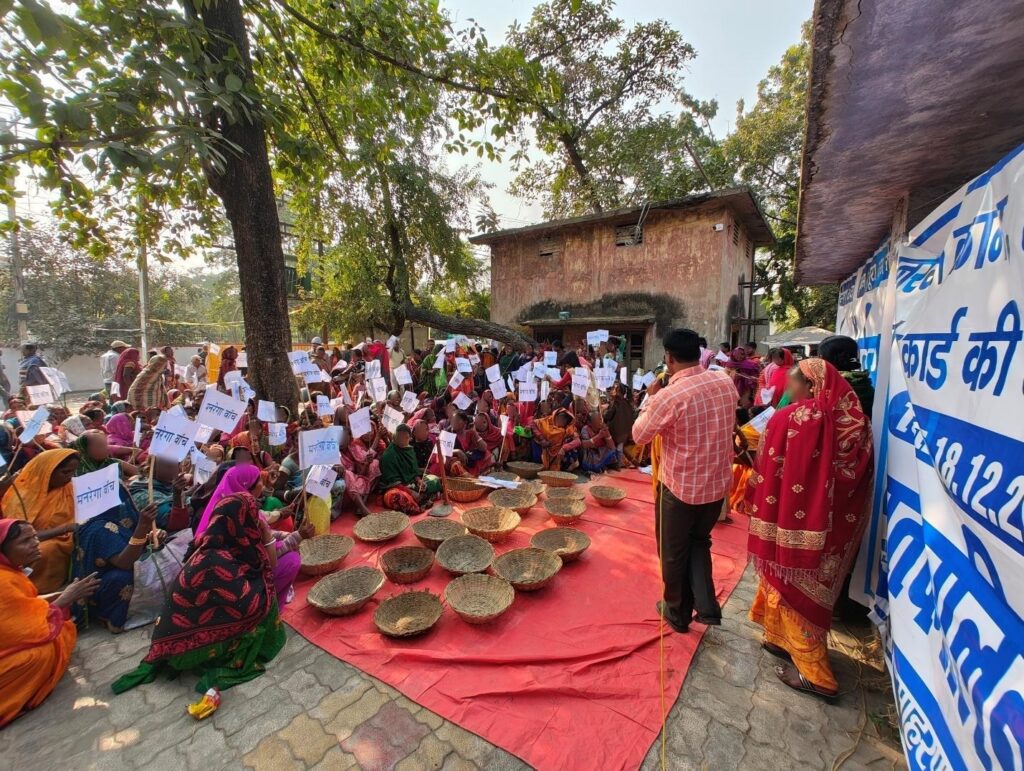
Figure 2: MNREGA Watch protest in December 2024 combining spatial occupation with cultural performance (source: Author’s own)
Resistance in Agriculture: Selective Appropriation and Collective Action
Bihar faces severe climate stress: annual flooding affects 73 per cent of its land area, monsoon patterns have grown erratic, and drought intensity in the south has increased (Gavali et al., 2023; Jeetendra et al., 2019). This vulnerability has attracted substantial investment in digital interventions — AI-enabled apps and chatbots that operate in silos, require separate registrations, and burden farmers with navigating competing systems without support.
Only a handful of farmers regularly use any agricultural application beyond basic weather forecasting. A farmer from Vaishali described her selective engagement: ‘The weather app said from the following Thursday, it would start raining. So, we did not irrigate our field. And when it rained, I just used urea afterwards’ (Interview, December 2024). She relied on Jeevika extension workers and peer networks for pest management, new varieties, and market information. Weather apps serve a bounded function. Relational knowledge handles the rest.
The risk logic is explicit. Farmers in Gaya explained: ‘We do not want our crops to get damaged. This can even affect our dal-roti. So we test innovations on small parcels before wider adoption’ (FGD, December 2024). Collective experimentation through Self-Help Groups distributes risk in a way that individual app-mediated advice structurally cannot. Non-adoption is rational risk management, not technological backwardness.
Labour Resistance Within Climate Governance Infrastructure
The same Jeevika infrastructure that outperforms algorithmic platforms operates, paradoxically, through exploitative labour relations. In September 2024, Bookkeepers and Community Mobilisers launched a three-month strike after a 2 September office order reduced monthly compensation from Rs. 4,800 to Rs. 2,560. Tara, a Bookkeeper from Guruva block, was direct: ‘After the office order, my salary decreased to 3,840 rupees. If I reduce my groups from 12 to 8, I will be getting 2,560 rupees. How will we survive on that?’ (Interview, November 2024).
Workers appropriated platforms designed for top-down communication to build horizontal solidarity. Strike demands extended to identity cards, permanent contracts, and social security benefits. The contradiction between Jeevika’s empowerment positioning and its treatment of workers was stated plainly: ‘They say women’s empowerment, but look at how they treat us. Nothing happens in 2,000-3,000 rupees’ (Interview, November 2024). The strike achieved partial success.
Towards Climate Justice Beyond Algorithmic Governance
Resistance across these three domains reveals several convergences. Digitalisation reproduces rather than disrupts existing inequalities: Rajam et al. (2021) finds more than 50 per cent of the caste-based digital divide attributable to historical socioeconomic deprivation. Alternative infrastructures consistently outperform algorithmic platforms. BMW’s documentation proves more reliable than official digital records; Jeevika’s relational networks deliver more sustained agricultural knowledge than app-based advisories.
Bihar’s MNREGA workers, Jeevika farmers, and striking extension workers are not resisting modernity. They are contesting whose modernity gets built, on whose terms, and at whose expense.
Acknowledgement
This blog draws on ten months of ethnographic fieldwork across two separate visits between November 2023 and January 2025, covering Muzaffarpur, Vaishali, and Gaya districts in Bihar. The research involved 108 interviews and focus group discussions with farmers, extension workers, bureaucrats, activists, digital technology consultants and development professionals. Telephonic follow-up conversations continued through 2025. All interviews were conducted with informed consent; participants’ names have been anonymised except where individuals explicitly requested identification. The research received ethical approval from Lancaster University’s Research Ethics Committee (Reference: FST-2023-3973-RECR-2). This work forms part of the Digital Climate Futures Project.
Vidya Pancholi is a Senior Researcher at Lancaster Environment Centre, Lancaster University, working on the Leverhulme Trust-funded Digital Climate Futures Project. His research examines digital technologies in climate adaptation governance across rural Bihar, India, using frameworks of political ecology, climate coloniality, and digital coloniality.