Gabriele Orlandi – Reinvigorating local epistemic communities around Alpine digital infrastructures
.
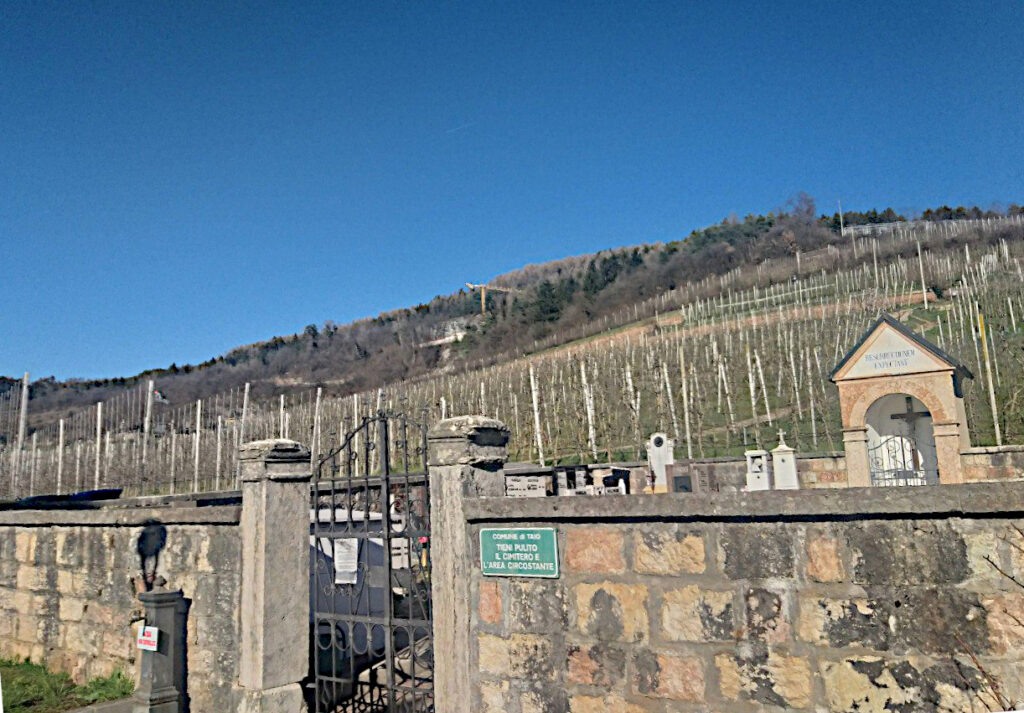
Image: a graveyard of one Alpine villages, with the apple orchards behind, and the building of a data-center under construction in the background. Photo by the author.
What are the politics of political ecology? How can politics and ecology be conjugated in practice? For several years, I looked at political ecology as a powerful analytical framework to unveil the political dimension of ecological practices and environmental regulations across different scales and settings. Trained in critical development studies and anthropology, my approach to political ecology—like that of many others—drew on concepts and methodologies from diverse disciplinary and intellectual traditions (Marxist theory, subaltern studies, the anthropology of development, public policy analysis, environmental anthropology, and economic geography, etc.).
I thought that this interdisciplinary framework would enable me to identify, describe, and critically assess power dynamics, inequalities, and structures of accumulation and dispossession within socio-ecological configurations. In this vein, my MA works were oriented in documenting the invisible consequences of European ecological transition policies on land rights of nomadic people in rural Western India. I then turned that same lens towards the Alps, the region where I have grown up. There, “failed” development projects, scientific approaches to mountain farming, and conservation-related conflicts gradually made me aware of the recurrent epistemic injustices that affect rural communities, even in Western Europe.
It was in this spirit that, during my postdoctoral fieldwork at NICHE – Centre for Environmental Humanities (Ca’ Foscari University of Venice), I unexpectedly encountered a project for a future data centre, planned for construction in the belly of the Dolomites. Although potentially huge, the economic and ecological impact of this infrastructure had been little discussed with the valley inhabitants. In a moment when this mountain area was reinventing its economic trajectory, opportunities for debating the project had been hampered by local authorities. Technical data about resource consumption has not been made available. This very absence of data made it impossible for people to decide autonomously on the soundness of the project. In other terms—and differently from my previous research experiences—room for politics was not only reduced, but consciously obliterated.This awareness strongly influenced my presence in the field. Instead of attempting to elaborate scenarios on my own regarding the long-lasting consequences of this infrastructure, and more generally about how the material ecologies of the Alps would have become a financial asset, I turned my field research into an exercise of public imagination and collective research. Privileges (times, status) connected to my scholar condition proved useful in creating and sustaining a local epistemic community, rather than only documenting it. Soon, the research became a collective effort. Interviews and talks became occasions for elaborating alternative imaginaries with NGOs, local associations, and inhabitants. Writing resulted into a powerful tool for opening new possibilities. I was no longer the only one questioning the future data centre and wondering what to do. My approach to political ecology has shifted: from revealing the unspoken political dimensions of ecology to ecologizingpolitics itself, by actively participating in an ecology of political practices.