Introduction
This report distils the main lessons and feedback from participants of POLLEN 2026 that comes from a survey sent out on 6th July and closing on 17th. The survey asked about the respondents’ background and then asked for free text responses to three prompts – what worked, what could be improved, and any other comments. I deliberately did not ask questions about pre-determined topics that could be answered in a likert scale (eg about food, the venues etc), instead soliciting open answers that could provide wide understanding of main pros and cons. Our free text respondents allowed delegates to comment (anonymously) on the things which are most salient in their mind. What follows is therefore not a collection of statistically representative opinions; they are comments to reflect on because this is what the delegates wanted to tell us about.
Most respondents were first time POLLEN participants (418 of 544 people). 156 people who took the survey provided no written feedback. Of the 388 who did, most were academics (374) and a plurality of these were PhD students (138). The tables of participation are included in the supplementaries. The vast majority of the feedback is constructive, balanced, and useful (326 comments providing both critical and positive feedback, 16 only critical, 43 only positive, 3 unclear). So, there is a lot of material to represent. As a whole it demonstrates a good deal of practical love for the POLLEN network as a whole. My thanks to all who took part.
For this draft report I have treated these as straightforward qualitative data, highlighting the common themes and issues that emerged across all these responses. I shall be including a diversity of feedback on every aspect. The point is not to provide any average view – there is no such thing – rather the range and variety of opinions. The quotations have been chosen for their clarity, many more statements could have been used.
But, from the outset, we must note that there is one crucial group that is almost entirely missing, and these are the 552 people whose work was rejected by the panel convenors from the 1974 applicants back in December 2025. Because they did not largely attend POLLEN, their voices are almost entirely missing from the feedback. But we need to remember what the views of the broader POLLEN network who did /could not come to Barcelona might be. Fortunately, one did attend. This is what she said:
‘My panel and paper were both rejected. I suggest:
- You have more panels and extend the time of the meeting by a day and have more parallel sessions
- You allow people to submit their papers to multiple panels. Perhaps three.
Something has to be done. This rejection feels bad. I do not think you should accept trash, but I do think something is wrong when a long-standing widely cited scholar who has submitted a panel and a paper that she considers well written and pertinent is rejected. It should not happen if you want to be taken seriously.’
Professor, previous POLLEN attendee
A similar point could be made about the cost of this conference. Given the early complaints when the fees were announced, surprisingly few people said that they thought it was expensive in this survey (20 did, 5 found it reasonable, 363 people said nothing). But if people were able to come, then they already were able to pay. The people who found this prohibitively expensive will have been missing.
And, more generally, because the survey explores salient issues, it does not establish the distribution of views on which people might agree or disagree. It is inappropriate to read anything into silences. The fact that 20 people said it was too expensive, and 363 said nothing about the cost does not allow us to infer that these 363 people thought the price was fair.
With these caveats, what were the most salient issues in the minds of the respondents who could attend? Below I describe POLLEN delegates’ views about the positive aspects of the conference, which shows that we got the main things right – the content, and the organisation. Second, I reflect on what we can learn from this feedback about having such a large meeting, and what are the implications for future meetings. Third, I discuss how we can benefit from this feedback to enhance and protect POLLEN’s conviviality. Fourth, I report back some suggestions for future content of POLLEN meetings. Finally, I list some of the specific issues on which we came up short so that future organisers are aware for next time.
Content, Organisation and Wonderful Delegates
Two issues stand out most clearly. First, the vast majority of people (over 200) appreciated the high quality of the content, with a substantial number of these 80 specifically praising the breadth, variety and diversity of the material being presented. This was the most salient issue in all the comments. In contrast, only 3 people were critical of the content. Here is one of the more complete statements which captures most of what people appreciated (and its predominantly academic leanings).
‘One of the strongest aspects of the conference was the high quality of the discussions during the paper sessions. The presentations were consistently engaging, and the questions and comments from both chairs and participants fostered thoughtful and constructive exchanges. This created an intellectually stimulating environment and provided valuable feedback for ongoing research. I also particularly appreciated the remarkable diversity of topics addressed under the broad umbrella of political ecology. The conference brought together scholars working on a wide range of empirical cases, theoretical approaches, and methodological perspectives, making it an excellent opportunity to learn about new debates, build connections across subfields, and engage with different geographical contexts. Overall, the conference was very well organized and successfully promoted meaningful academic dialogue.’
Professor, first POLLEN
Box 1: Happy Campers
Second, there were many compliments about the quality of the organisation. This was the second most salient issue, with over 170 positive comments (3 were critical). Furthermore, many people were not merely mildly positive, there was an exuberance, an energy and joy in their enthusiasm that I have tried to illustrate below (Box 1).
| Absolutely adored the plenaries and overall how the conference was organised. I loved that there were multiple side events which really interacted with Barcelona’s culture, amplified by the incredible venue location! Doctoral Student, first POLLEN |
| Really wonderful, well done. Amazing to produce a conference that felt like this, addressing the issues POLLEN addresses, in an academic climate as hostile as it is. Gives me hope! Post-doctoral researcher, first POLLEN |
| Massive thanks to the organisers and one of the best conferences I’ve ever been to in nearly 20 years of attending many conferences. Professor, first POLLEN |
| Loved the conference. Like a sweetie shop for the mind. The building worked really well, the trip to UAB was easy and the building amazing; the location perfect. . . . overall it was an absolutely fantastic experience – and I feel (and I really hope this remains) a very welcoming, peer to peer, non hierarchical, horizontal event, where ornery folk and PE rock stars, masters students and wildly senior and respected academics, all talked and learned and listened and ate together in those rooms. The organisation was faultless, to be honest – lots of silent graft in the background which made it all work extraordinarily well. Professor, first POLLEN |
| The conference was excellent; the presentations—both panels and plenary sessions—were of very high quality. The people were cheerful, critical, and hardworking, participating with great energy. There was plenty of food and drink, and the organization was superb. It was important to ensure representation from various continents at the plenary sessions. It was certainly one of the best academic experiences of my life. Professor, first POLLEN |
| This was one of the best conferences I have attended in recent years. The quality of the participants was outstanding by a wide margin. It also gave me the opportunity to learn about a remarkable range of research from scholars working in different parts of the world. Lecturer, first POLLEN |
| I thought the conference was on the whole very well run. You could tell a lot of thought and effort had been put into every element of the conference, from programming/scheduling, to venue management and communications. Although I don’t have kids I thought it was great there was capacity for people to bring children, and I appreciated the work/quiet rooms. The receptions were very generous compared to many other conferences I’ve been to. Whereas some conferences can feel a little soulless this one definitely felt very thoughtfully designed! Lecturer, first POLLEN |
| I absolutely love the atmosphere. I loved the proportion of young people and the spread of nationalities. The final party was one of the best nights I’ve ever had. I thought the nomadit organization was fantastic and would love to recommend the organization for future conferences. In particular, the interface for exploring, the panels was really really good and especially given that there was so so so many of them. Professor, first POLLEN |
| I absolutely loved the conference. The atmosphere was very welcoming and the sessions were very inspiring. It felt quite big, which can sometimes be slightly overwhelming, but I also understand the challenges contained within organising such conferences and know that there’s a balance to be found between letting a conference become too big and having to turn down many hopeful participants. I thought that there was a good limit to the accepted number of participants (I wouldn’t let it grow more than this, as it can become too much like other conferences). It was also good that there was food available at a reasonable price in the main building of the conference (for most of the days anyway, except for Tuesday), as this makes it significantly easier to attend. Every volunteer was very kind and helpful! Doctoral Student, first POLLEN |
| The variety of activities was fabulous – while I did not participate in everything I feel like they really contributed to the overall atmosphere and energy of the conference. The inclusion of so many new-to-POLLEN scholars was also really special and made me feel like this was a very inclusive group that is actively growing and thinking carefully about the world. The online schedule was extremely user friendly and easy to keep up to date with everything each day, way better than other conferences that use apps. The Plenaries were really interesting. The party on the last day was also fantastic, best end of conference I’ve ever attended, such an incredible venue, with an amazing band and DJ and vibe overall! I thought it was also very interesting to engage so critically with tourism in Barcelona, and so how well the topicality of the conference and location overlapped was really exciting. I wish the meetings between sessions could have been a little more conducive to mingling, it was quite loud in there and not a lot of seating or separate spaces for socializing. The German film house for the movie showing was really cool too. Doctoral Student, first POLLEN |
The quality of the content, and the friendliness of the gathering reflects the people who came. If POLLEN 2026 was a success then, fundamentally, that is because its delegates made it so. But given the size of this gathering, and how hot and expensive it was, the organising committees should also be glad that despite these hurdles, their efforts paid off so well for so many people. An important source of the contentment were the extraordinary efforts of NomadIT and the volunteers, whose communications and efforts were mentioned by 68 respondents (Box 2). Further, where there were complaints about the organisation (with respect to the final party and the workshop locations at UAB), these were aspects that NomadIT were not running.
Box 2: Comments on NomadIT
| The organization of the conference was systematic, the plans and outline lucid, and the NOMADIT team fantastic. Some of the panels were interesting, satiating curiosity. Doctoral student, first POLLEN |
| NomadIt was a great call. Doctoral student, first POLLEN |
| The sessions I attended were interesting. I particularly like the creative offerings including the sensory walk. I had some wonderful conversations with a few people. The general atmosphere was friendly and welcoming and the NomadIT team were great. Doctoral student, first POLLEN |
| Well organised despite being huge. Good panels. Good online program though would have appreciated looking at printed program om first day for better overview. Nobody said those were available. Nice to visit also UAB. Nice entertainment and plenty of mingles. Great with fan! Nomadit were great. Professor, previous POLLEN attendee |
| I really enjoyed the conference over all – it was great to see so many people that I know and to have the chance to meet a lot of new people. One of the things I love about POLLEN, and Barcelona was a very good example, is that it draws a relatively young and radical crowd so the atmosphere is different to regular conferences which can be very stuffy and boring. I appreciated the daily emails with updates and advice from the POLLEN and Nomad team – a critically important one was telling us to bring a packed lunch on Tuesday! Very good advice. I think the organising team should be congratulated for pulling off a magnificent achievement. The Nomad team and volunteers were super and very helpful. Professor, previous POLLEN attendee |
However, even though there was overwhelmingly positive feedback with respect to content and organisation, it is important also to listen to the disappointments (Box 3). These pertain to aspects of the organisation and content, and some of the practical arrangements around food and venues.
Box 3: Discontent
| The organization of the conference in general, especially the logistic was very problematic. I missed a common space close to the venue to have lunch all together, I didn’t get the logic of going to the UAB on Tuesday and I didn’t like the fact that the Museu Maritim was very far from the main venue. I also missed a proper place for the plenary that gave a sense of community. Professor, first POLLEN |
| I am actually quite disappointed with this conference. It is the first and probably the last time I will attend. The plenary sessions completely ignored current events in Palestine and Lebanon, namely the ongoing genocide and erasure of Palestine, the ongoing destruction of southern Lebanon, and the latest war on Iran. There was no mention of the expanding imperialist and Zionist settler colonial project in the region and its ramifications on global energy. As such, energy imperialism was ignored. I find this disturbing, as it disregards the issues that should be at the heart of academic debate and mobilisation. Also, the conference was packed with sessions that were more or less the same, and this could have been avoided by making a more careful selection of proposals. Moreover, the conference programme was hard to access online every time I wanted to look up sessions. Admission fees are very expensive, and not sure for what exactly! Lecturer, first POLLEN |
| Overall, I felt the conference could have been better organized. Holding events at two separate venues, one of them located quite far from the city center, was inconvenient and at times confusing for participants. In addition, many of the session rooms were small and uncomfortably warm. The catering was also disappointing. Given the exceptional culinary standards and the wide variety of excellent food available throughout Barcelona, the meals provided were unexpectedly poor and did not reflect either the location or the cost of attending the conference. Doctoral Student, first POLLEN |
| Sinceramente, no me ha gustado el Congreso. Para ser un Congreso de Ecología Política, el ambiente era tremendamente colonial, sin espacios a otras lenguas. Y es caro, lo que me ha impedido ir todos los días. Solo pude pagar asistir un día pues mi entidad está en una situación de quiebra. El caso es que acudí la mañana anterior al día que tenía inscrito y en el momento de recoger mi acreditación, se me indicó expresamente que no podía asistir a ninguna mesa (¿en serio?). Y me sorprendió el ejercicio de “catalogar” a las personas participantes, con acreditaciones de colores diferentes (eso os lo tenéis que re“isar, que”a feo). Por último, el cátering ha sido lamentable (unos bocadillos de un resto mínimo de queso y tres finas rodajas de pepinillos?, con un mal pan, por ejemplo), la fruta (al menos algo de fruta) escasa. Sinceramente creo que se podría haber elegido algo de mejor calidad (que se ha celebrado en Barcelona!) y con menos plástico. Y sinceramente, para dar un abanico de mala calidad, mejor ahorrarse el dinero. Lecturer, first POLLEN |
How to Create an Abundant POLLEN? Coping with our Size
Perhaps the most interesting and contested aspect of the conference was its size. Was it too big (too many people and papers), too intense (too many papers in panels, too many panels at once) and too long (long days and too many of them)?
The short answer to that is ‘Yes’. 103 thought it was too big in some way (Box 4), making it the third most salient issue in the feedback. These views were evenly split between first time and more experienced POLLEN goers, although there was a tendency for more first-time attendees to find the intensity (number of presentations per panel) harder.
Box 4: POLLEN 2026 was too large
| Smaller is better! It was too huge, which is good to bring a lot of people, but maybe just me, I was overwhelmed. Doctoral student, first POLLEN |
| It was too big, too many days, too many sessions on one day. Everyone i spoke to was happy overall, but completely exhausted at the end of it. I realise this is hard, but I would’ve limited the amount of people at the conference (and thus rejected more people). Doctoral student, first POLLEN |
| La duración es un poco larga. Entiendo de que hay muchos ponentes. Y muchos temas interesantes. Pero podría dividirse por ejes temáticos, de manera a hacer conferencias más cortas. Aun que sé que es difícil Lecturer, first POLLEN |
| My main and really pressing concern was the overcrowded character of the conference. Hearing five or even six presentations in a panel, sitting in packed rooms basically all the time, and having very little time for Q&A was simply exhausting. The breaks and receptions (at UB at least) were also crowded and thereby overly noisy. As political ecology is about inclusion, I understand that you accepted many applications. But it is also about degrowth, slowness, and mindfulness – and this came way too short in the conference. For future POLLEN conferences, which I will certainly attend, I would much appreciate having four presentations maximum in a panel, having more time for discussion, and including more roundtables, flash talks, or alternative panel formats. Overall, a more intimate conference settings with better discussion opportunities would be nice. Post-doc, previous POLLEN attendee |
| I was a little overwhelmed with how many people and sessions there were and I miss the intimacy of the smaller conferences in the past. I don’t really know how to address this though. Post-doc, previous POLLEN attendee |
I personally conclude -on the basis of feedback and also on my experience during the conference- that we should not look to have bigger conferences in the future. But please recall the views of the 552 people whose work was rejected. For them, this conference was likely not large enough. Also note that there were few indications that the quality of the content suffered because of the conference’s size. Complaints that presentations were weak were few. On the contrary many were glad for the diversity. In this respect the abundance on offer was both welcomed and a worry. Furthermore, there were some interesting exceptions from people who welcomed its size, 22 people specifically mentioned that they appreciated having a larger, and most especially a longer conference (Box 6).
Box 5: POLLEN 2026 was the Right Size
| PE is a growing filled and you managed it well – 5 days is long but it didn’t feel huge and anonymous. Thank you Lecturer, previous POLLEN attendee |
| I enjoyed the sheer diversity of panels and the very many ways in which people are doing political ecology. Being spoilt for choice in a conference is something i appreciate. Researcher, first POLLEN |
| I liked the length – yes, it was a lot and many days but by having it spread out over so many days, there was a chance to meet people several times and recognize each other in the hallways, so that conversations could happen more naturally and there was no need to ‘catch’ interesting talking partners right after their presentations all the time. It made social interactions feel less stressful. Lecturer, previous POLLEN attendee |
| Please keep the conference large and inclusive, especially of young scholars! Because of the bi-annual nature of this event it is sort of a once-in-a-PhD opportunity for International students, and that made such a huge impact on the energy of the conference and of my understanding of where political ecology sits and where its going as a discipline overall. The variety of activities was also just phenomenal, and the importance of experiencing joy and walking outside together and movies and engaging in many different venues just was so important in integrating ideas with location and body, and getting to know everyone and each other so well. Outstanding experience, thank you!! Doctoral student, first POLLEN |
Interestingly, of all the people who felt the conference was too large, I did not get the impression that they thought that their own work, or their friends’ work, should be excluded. No one said that they themselves were the cause of the over-crowding. If I am correct, then this is a rather painful observation. POLLEN gatherings may suffer from having too many people at them, but is there then also a tendency for us to replicate exactly what David Harvey found objectionable in Malthusian approaches to overpopulation?
‘what are the political implications . . . of saying there is “overpopulation” or a “scarcity of resources”? The meaning can all too quickly be established. Somebody, somewhere, is redundant, and there is not enough to go round. Am I redundant? Of course not. Are you redundant? Of course not. So who is redundant? Of course, it must be them.’
Harvey, ‘Population, Resources and the Ideology of Science’, 1974: 273
We need to be careful if we do consider the question of who may be redundant in a POLLEN conference.
One approach would be to tighten what is defined as political ecology. This was suggested by two delegates (Box 6).
Box 6: Tightening the definition of Political Ecology
| For me, the conference was too big, too many people and this was overwhelming. I had a constant “fear of missing out” on important things. Some panels had papers that I would not classify as doing political ecology per se. This made me think that to be inclusive, inputs were invited that had only marginal overlaps with political ecology research – of course, this is a heterogeneous field and who can really set boundaries around it! However, there are some specific characteristics such as an attentiveness to power, reflexivity from the researchers’ side, (progressive) contextualization. Lecturer, previous POLLEN attendee |
| Too many panels and lots of overlaps between them! Some presentations weren’t really from political ecology. I think we are at the moment where the boundaries of what is PE and what is not PE should be defined. Post-doc, first POLLEN |
Ideally, we need to avoid the notion of redundancy altogether by creating alternative formats, or approaches to POLLEN, that create abundance, nor scarcity. Some of the challenges of large conferences could be address not simply by limiting the size, but also by tackling the expectations and attitudes of the attendees.
First, participants could accept more easily that they can only make limited number of contributions. It was remarkable how many people tried to submit two panels, despite the instruction only to send in one. Cleaning that up took a lot of work. When I asked a friend which of their two panels they wanted to go forward, they joked in reply ‘You caught me’. Of course I did. You were trying to hide on a spreadsheet 🤦🏼. But the more serious point is why treat this as a game whose rules one tries to evade, when the rules are designed to created space for people.
The gaming got more problematic at the paper submission stage, after we tightened up the software to allow only one paper per person. One person sent in two different papers using two different identities – and someone else registered with three different IDs to send in three papers (!) Once again, this sort of behaviour takes space and opportunity away from people.
Changing our practices of participating in the conference may also temper the complaint I heard that it was a long way to come to Barcelona only to present once. That view is right if presenting work is the purpose of conference attendance – but wrong if listening to other people’s work also counts. Living within our limits will require learning a different approach to sharing conference space.
One lecturer, attending their first POLLEN, highlighted how the problem may not lie with the number of panels but our attitude to them. They did so by likening the problems a large conference caused to an eating disorder, observing that so many presentations on offer induced ‘bulimic cravings of knowledge.’ Please do not take this as a light-hearted comment. I do not think it was intended as such, and I certainly do not treat it so. Rather, the comparison is useful because it crystalises the way the knowledge abundances at large conferences may be approached. Addressing problems of abundance and/or imbalance – in different social and psychosocial realms – often requires looking beyond the object itself. It is not merely about the amount of knowledge, or food, available. Instead, it requires considering the systems of beliefs, imaginaries, and attitudes though which abundance is experienced and understood.
Thus, if a large conference feels overwhelming, or causes ‘FOMO’ (Fear Of Missing Out), then reducing the number of panels may not be the best solution. Two good parallel sessions could still cause FOMO. Better solutions might include helping delegates to focus on where they are at the moment, and all they are learning, rather than what they might be missing. As one respondent observed:
‘Could have included more on the “inner dimension”, i.e. the inner capacities that we can nurture to enable us to take the emotional and mental load of all the knowledge and experiences we deal with, and, crucially, to enable us to step out of our own silos so that we can connect the dots and “join forces” as we work towards redressing structural/systematic inequities and modes of governance that are not compatible with our planet.’
Researcher, first POLLEN
Healthier approaches to conferences, their abundance and aims, and being intentional about the space we create, could also be cultivated by panellists and panel convenors. A lot of thought went into that from the organisers. We needed to think how to spread that approach more pro-actively among the participants.
‘it would be nice to have a central(ized) call of encouragement for speakers to introduce and situate themselves . . . It felt quite alienating to be at a conference seemingly centering the political and wanting to decolonize etc, but not taking the time to actually introduce ourselves, being transparent about our positionality and where we are situated in relationship to our work. . . . I would love if there was a more active attempt and encouragement for conveners and speakers and participants to be more intentional with the spaces they create, be more embodied and relational (even if that means doing less).’
Doctoral Student, first POLLEN
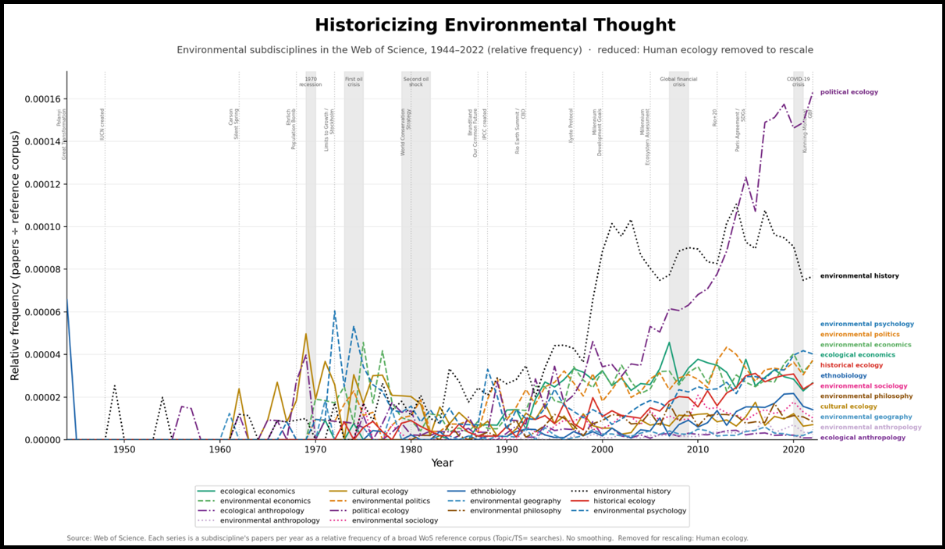
Changing practices and expectations of conference attendance may not happen fast enough. All the evidence suggests that political ecology is gathering ever more momentum as a means of understanding environmental challenges. Indeed, it is the biggest such science by some margin (Figure 1). These data demonstrate that the push to be bigger and more inclusive will not go away, and given the benefits people have enjoyed from this gathering, we need to find more ways of allowing more people to experience them.
Figure 1: Booming Political Ecology
The most obvious solution is to think of ways of spreading the focus beyond a single biennial event. There were several suggestions to that effect (Box 6).
Box 6: Disaggregated Meetings in the Future
| The conference was excellent by all accounts. Yet, we (that’s POLLEN), still need to consider having ‘mini-POLLEN’ conferences that a) are much less overwhelming, b) provide more ‘space and time’ to engage in fruitful conversations, and c) more frequent and in more diverse places (ie. people still have to go thru xenophobic border regimes to arrive in Schengen zone, UK or else). |
| It would be good to see smaller and thematically more focused political ecology conferences in the future. Professor, previous POLLEN attendee |
| Perhaps consider organizing smaller POLLENs with a narrow focus/theme to allow more regular but also more specialized POLLEN conferences in different locations. e.g. a conference on conservation only, a conference on climate politics only, a conference on multispecies ecologies, a conference with a regional focus (asian political ecology), etc etc Professor, previous POLLEN attendee |
| I think the idea of having a larger biennial POLLEN conference alongside a smaller annual event is very interesting. It would help maintain momentum within the network while making it easier for more people to participate each year. It could also be valuable for each edition to focus on a specific theme or topic, allowing for deeper discussions and greater continuity around key debates within the POLLEN community. Post-doc, first POLLEN |
| At least one of the practical aim of the conference should be to blur the boundaries of the theoretical production, or eventually this could results in a more of an Academic Ecology than a Political Ecology. Creating one big conference is glorious, but it leave a lot of pieces behind. Maybe it could be helpful to organize more little conference divided by areas, thus to capture local experiences in more fine-grained way. That said, thank you for your incredible effort in organize this event. Post-doc, first POLLEN |
| The conference is getting huge… maybe it should be broken up a bit somehow otherwise nobody will want to take on organising? Though it is great to meet a lot of key colleagues at one event. Not sure how to deal with the size. Professor, previous POLLEN attendee |
As we shall see below, smaller meetings may be a useful vehicle to avoid gated-academic POLLENS. Further, one means of encouraging this, and promoting local issues might be to make meetings cheaper for local people as this person observed:
‘The exorbitant price prevented many local researchers from participating, leading to the gentrification of academia. There should have been nominal fees for participants from Catalonia and Spain. In my view, this is not very consistent with the principles of political ecology.’
Doctoral Student, first POLLEN
There is a counter view, namely that a local conference is already cheaper for local delegates because they are not paying for travel or accommodation. But were disaggregated meetings to encourage local attendance, then they might become more of a focus, relieving pressure on the biennial event.
More, smaller and locally focussed meetings would also, ironically, deal with POLLEN’s Eurocentricity. A locally focussed meeting in say, Germany, would be even more Eurocentric, but deliberately so, and balanced (across the network as a whole) by other meetings beyond Europe. This was also mentioned several times (Box 7). More locally focussed meetings could also be more inclusive of other languages (as we review in the next section).
Box 7: Eurocentrism and Conferences beyond Europe
| It’s very Eurocentric. The plenary on “Democracy” vs “Authoritarianism” was very emblematic of the trend, where it’s assumed that western ways of doing things are inherently good, but just corrupted somehow by capitalism. There were no diversity of views in that plenary, in my opinion, as they all assumed the framing which comes from anticommunist US-based think-tanks. It would be nice to see explicitly anti-imperialist aspects of non-western traditions drawn out and highlighted generally to put the Eurocentric “political ecology” in more contact with other approaches. Tensions towards China were common throughout the conference, but there wasn’t space to constructively dialogue about it between Chinese and non-Chinese scholars. Post-doc, first POLLEN |
| Most importantly there should be great care and great sensitivity to Eurocentric and colonial voices in regards to indigenous, subaltern, and colonised communities. In many sessions the white saviourism and romanticisation was so present I left a few sessions. Doctoral student, first POLLEN |
| as a first-time attendee, I found the conference to be slightly Eurocentric. Given its history, this is perhaps understandable, but I hope it will continue to broaden its geographical diversity among both presenters and participants. Doctoral student, first POLLEN |
| Perhaps we could consider holding future conferences in different, more centrally located and affordable regions to make them more accessible and enable broader participation from both the Global South and the Global North representations. Doctoral student, first POLLEN |
| Maybe it’s good to have a global South venue at the same time to enable more majority world participation Professor, previous POLLEN attendee |
| Maybe having satellite conferences, as many from the south did not attend because of visa issues and because of how expensive it is to travel to attend conferences. Outside academia, first POLLEN |
| An event that emphasizes openness and inclusivity should not be held in a region that has as many barriers to entry as the EU zone. It puts the onuses of finance and labor on communities that are already underrepresented. Doctoral student, first POLLEN |
Maintaining POLLEN’s Care and Conviviality
One of the reasons why we have to be so careful of POLLEN’s size is that size is a fundamental factor in shaping the feel and experience of the conference. People have come to appreciate its intimacy, especially compared to other conferences. When it works it can provide a nourishing space where people feel welcomed (Box 8). In the main we can celebrate that the atmosphere was once again mostly convivial. 70 people mentioned how much they appreciated the atmosphere (the fourth most salient aspect), with only two critical comments.
Box 8: Good Vibes
| It was great. Wonderful size and great vibe. Lecturer, first POLLEN |
| There was a really nice vibe throughout, friendly and egalitarian. Lecturer, previous POLLEN attendee |
| [What worked?] Everything! I liked that there were many people outside of PE, bringing in new theories and approaches. very well organised, community vibe was maintained, everybody welcome. Professor, previous POLLEN attendee |
| I had heard about the conference from colleagues who participated and it fully matched my expectations. Most panels were very high standard, critical but respectful and engaged debates. POLLEN manages beautifully to balance between creating a serious academic environment and a very chill atmosphere. Lecturer, first POLLEN |
| The conference was well-organized. At least within that space, a great measure of equality was maintained between participants. This was refreshing, given that some of us who live and work outside the centers of western academia cannot help but be aware of the deep structural inequalities of academic thought and organization. Professor, first POLLEN |
| In general, it was evident that the team organising the Conference was working in harmony and cooperation. This added to the general positive attitude of attending people. The times ran smoothly and the panels were of high quality. I feel intellectually and personally nourished after the Conference, so my deep appreciation to those who made it possible. Post-doc, previous POLLEN attendee |
| It was a space for debating plenty subjects within climate change. So many good panels and plenaries. Also was a safe space for diversity. I felt very welcomed. Doctoral Student, first POLLEN |
| overall, I felt the vibe was constructive and built on true curiosity (as opposed to some conferences where it seems to be about who can perform the most critical-seeming comment. Post-doc, first POLLEN |
Once again, as with the praise for POLLEN’s content, this sort of feedback reflects the fact that convivial people attended and were kind to each other. The experience of POLLEN is as good as its delegates.
POLLEN 2026 faced a number of challenges that threatened the normal kindness POLLEN delegates show each other. It was large, with many new people and the weather was hot. Further problems of misconduct (harassment, disrespect, unkindness) are far too frequent in academic meetings. We therefore released a code of conduct that was sent to all delegates shortly before the meeting to remind everyone of the sorts of behaviour expected. This was mentioned by one delegate, and may be something to replicate in future meetings:
‘I really appreciated the code of conduct/ care principles. I think this helps sustain the very nice and constructive culture that POLLEN seems to have (based on 2024 and 2026).’
Doctoral student, previous POLLEN attendee
But, unfortunately, the caring atmosphere was not universally experienced (Box 9). We need to be more vigilant in caring for our care.
Box 9: Unpleasant experiences
| In general the audience spirit was kind but I encountered some arrogance and hostility in one or two sessions (one directed towards a colleague who was devastated) which was very unnecessary – it was tricky to identify and confront the persons after the fact. Perhaps some guidelines for Chairs to deal with such situations? Professor, previous POLLEN attendee |
| I found some of the participants and the general feeling of the conference sometimes overly critical, to the point I witnessed some questions being outwardly mean and interrogative. Personally I didn’t feel like I made any good contacts, or had time to receive any decent feedback on my work, as the sessions were so full also. It was really busy and because of this negative experiences of other questions people received, I felt more intimidated by the experience. I personally, don’t think I will attend POLLEN again, although the session content and breadth was excellent. Doctoral student, first POLLEN |
| I appreciated the guidance on harassment and the idea of values that would guide us for the conference. This was excellent practice by POLLEN. However a small number of delegates did not align with the POLLEN values that were sent out in advance. This was really upsetting especially as one was a high profile guest. Professor, previous POLLEN attendee |
Three other practical aspects of developing more convivial approaches need to be highlighted. Most straightforwardly (but also ambitiously) we could speak more languages and develop approaches that allow multiple languages to be used (slides in one language, presentations in another, pre-circulated summaries etc). We could have had much more Spanish and Catalan at this Barcelonan conference.
Box 10: Building linguistic diversity
| No recuerdo haber recibido indicación que la lengua para presentar trabajos y exponerlos era exclusivamente ingles, de hecho en mi caso envié la ponencia en español y no me realizaron ninguna observación respecto al idioma. Considerando que el lugar de encuentro y anfitrión era de habla hispana/catalana, creo que debería haberse incentivado a utilizar también el castellano o catalán, o al menos considerado que podría combinarse al menos dos idiomas. Creo que en un congreso de ecología política donde se apunta a discutir relaciones de poder, equidad y justicia, la diversidad de lenguas es algo para considerar también en procesos de colonización y desigualdades de poder, incluso si se espera que la academia y los territorios se acerquen, hay que revisar la accesibilidad de estos espacios para diversidad de actores. De todos modos, muchas gracias por todo el trabajo y esfuerzo para este gran encuentro, se nota todo lo que hubo detrás y el amor que le han puesto! Un gran abrazo! Doctoral student, first POLLEN |
| En general creo que es bueno al menos hacer algunos guiños al idioma local, en este caso catalán/castellano, se me hizo algo raro que todo fuese en inglés. Doctoral student, first POLLEN |
| Another question that I think it’s important is to open the room for more than English spoken sessions, particularly when the conference is hold in a non English speaking country. Local struggles are also important and they tend to be better explained and represented in the local languages. Lecturer, previous POLLEN attendee |
| It is not good that english be the only language. More inclusive approach must be applied. Also, more alterantive scholars from Global South should be included. This will enrich a lot the discusions. Other academic, first POLLEN |
Childcare was an important innovation in this POLLEN and much appreciated. It was used by less than 15 families and was positively mentioned six times. There were also some basic and easily executable means by which this could be improved.
Box 11: Childcare
| Wonderful people and good vibes. I really appreciate efforts at inclusion, including the provision of childcare. Lecturer, previous POLLEN attendee |
| You’ve set up specific areas for working and for taking care of the children: I think it’s admirable that you managed to organize all of this in advance, for a conference fee that’s quite reasonable. Professor, first POLLEN |
| Care infrastructure. Child and parent room was just an empty classroom. A changing mat on a desk and one comfy chair for breastfeeding are easy to source and would have made a difference! Senior Lecturer, first POLLEN |
Finally, we need to be more careful about disability and health considerations. This respondent summarises the issues well:
“The venues were far apart, which is great for some, but acts as an obstacle for those with disabilities and senior scholars. The heatwave exacerbated the situation (perhaps think of having when the weather is more pleasant?).”
Lecturer, first POLLEN
More online participation would also be more caring, as rather forcibly expressed by this delegate:
‘There were so many extremely sick people just sitting in sessions unmasked and coughing all over people not even covering their mouths. It was extremely not disability friendly and I left the conference too sick and incapacitated to do the international research I had been planning for a year to do afterwards. Please have masks available and ask sick people to zoom in instead of selfishly putting everyone else at risk.’
Doctoral student, first POLLEN
Some of these problems were built into this gathering from the start when we decided to host it in Barcelona. The availability of venues in Barcelona did not give us any choice except to hold the meeting when we did, when there were also many tourists present. Barcelonamn political ecologists were pleased to host this conference, and well over 100 attended, but the appeal of visiting the city may have inflated delegate numbers, adding to the overcrowding. Being strategic would also mean choosing times and locations where heat is not a danger and the lack of beautiful beaches and buildings do not tempt people in. This statement captures the problems best.
‘I think it was the wrong venue at the wrong time. Barcelona during peak holiday season (combined with summer strains) was an unnecessary burden on the city that was hosting us and a burden on the infrastructure of the city. Many Catalans are not particularly fond of tourism expansion, we were adding to that strain in peak season.
It was also personally uncomfortable; the rooms were often too small, over-crowded, not air-conditioned. . . I am able bodied, I imagine this conference was incredibly difficult for those who are not, or who might be more susceptible to heat than myself. If we cannot provide physically safe spaces, we should not proceed. The ‘unprecedented’ heat-wave or spike is no excuse; we are a group of people incredibly aware of climate change, social strains of tourism, the conditions of university infrastructure. There really is no excuse and I find myself quite embarrassed to have convened and contributed to the load on the city.
All this to say, that if it was a different venue in an off-tourist non-summer season, it would have been marvellous.’
Doctoral Student, first POLLEN
Thoughts on Future Content and Engagements
With respect to the content, one of the curious tensions in the feedback was the attitude to the presence of civil society organisations and activists. 17 respondents mentioned that they wanted more civil society representation, 4 thought there was good activist representation, and one wanted fewer activists. I show this variety below.
Box 12: Different views on activism and civil society movements in POLLEN
| Social movements, civil society was absolutely absent: too academic! Professor, previous POLLEN attendee |
| Connections to city and civil society/left politics: almost missing, POLLEN appeared as being a gated academic community –> invitations to radical initiatives from the place or region to connect/present their work. Doctoral student, first POLLEN |
| I feel that the location had a lot to offer in terms of political, social, cultural, and environmental activism, and these were not given a space at the conference. I wish these were more present and bridging it to academia in some ways. Doctoral student, previous POLLEN attendee |
| I really liked almost all the panels, plenaries and informal meetings with the people. As someone who works at the intersection of academia and practice I found the conversation was too localized on the academics part. Since Pollen is growing and it would be great to have people from non-academic spaces like civil societies and those who work in global south and work with indigenous communities, their inclusion and their forms of knowledge should also be included in. Not in academia, first POLLEN |
| Importantly: There was a real lack of community engagement, often felt very ivory-towerish in the discussions – perhaps some of the funding could be ring-fenced to enable this engagement next time? It felt contrary to the spirit of POLLEN in its absence. Professor, previous POLLEN attendee |
| One of my favorite aspects of the conference was the inclusion of non-academic discussion groups throughout the program. People who had never met before were brought together to discuss a particular topic in small groups and then share their ideas with everyone. I would strongly encourage having more activities like these. Lecturer, first POLLEN |
| I loved the interweaving of science and activism, interdisciplinary and critical, by representatives of the world’s most cutting-edge scientific communities. It has been very effective in establishing lasting bonds through direct contact. The organization has been magnificent! Professor, previous POLLEN attendee |
| I believe POLLEN has real value as a space where critical, empirically grounded work can be shared internationally, but it sometimes felt a bit like an activist echo chamber rather than a forum for scholarly debate. I think the conference needs to actively cultivate internal disagreement and question dominant assumptions. Post-doc, previous POLLEN attendee |
These views reflect a tension in the POLLEN network as a whole. It likes to think of itself as not merely an academic network but something which is more actively and practically engaged. Elements of it are, but the vast majority the POLLEN nodes are University based. There are few civil society organisations present as members. This has the potential to lead to problematic interactions. One comment expressed a desire for more engagement, but it is not clear that this stemmed from a stated need from these organisations to have us engage with them.
‘Engaging with the issues of the city we were in, planning visits or dinners in the communities that are struggle the most, giving back to them somehow.’
Doctoral student, first POLLEN
We have to be careful about inviting organisations to take part on our terms, rather than theirs, or ‘giving back’ because we need to, rather than the organisations want it. This was the cautious approach we used in Barcelona, inviting engagement, offering free tickets and speaking opportunities. But we did not try to construct interactions that would have looked good to attendees while not reflecting actual interactions.
We need to recognise that POLLEN has become and is becoming increasingly academic. There are two aspects to this. In times of increasingly neoliberal academia, and when social sciences and humanities are being defunded on a massive scale this may make the gatherings an important place of refuge and support. Being a researcher in such environments can entail being an activist. The divide between the two worlds breaks down. Several of the comments reflected that.
Alternatively we could prefer a more stringent definition of activist, in which case it might paper over the general lack of activists in the network for the purposes of a biennial meeting. We will need to address this in the long term. POLLEN plainly benefits from the engagement of people beyond the academy and they from it. I have copied at the back of this document one letter I received that captures some of the benefits rather colourfully. Perhaps in Brazil (if the next POLLEN is held there), where interactions between academia, activism and civil society are different, so too can the form of POLLEN (Box 13).
Box 13: Breaking the Divide between Academia and Activism, from a Latin America perspective
| I missed the presence of leaders from social movements, Indigenous peoples, traditional communities, and environmental organizations. From the perspective of Latin American political ecology—which emphasizes the convergence of theory and practice—this element is essential. The plenary sessions could have included the participation of leaders from all continents, with their travel funded by the organizers, and local or regional movements could have been highlighted at other times. Professor, first POLLEN |
| For the next POLLEN in 2028—especially given that it will be held in Brazil—there could be greater emphasis on this aspect: social movements, Indigenous peoples, environmental organizations, and traditional communities. They should be viewed not merely as “objects of study,” but as historical subjects and political actors—and also as scientific subjects, in the sense of taking a leading role in research. Professor, first POLLEN |
And, at the same time, the academic tendencies of POLLEN might also be addressed by rethinking the questions political ecologists are encouraged to ask. Several respondents made thoughtful comments on this issue. One concern was about doing better analysis.
‘I’d encourage the organizers to think about how to protect analytical depth and disagreement within panels. Across several sessions I attended, discussions tended to converge quickly on a shared set of framings (e.g. “extractivism,” “green colonialism”) that were treated as conclusions rather than as hypotheses to be interrogated. It seemed that there was limited space for genuine debate about their explanatory scope or limits. This risks political ecology becoming a space for mutual affirmation rather than for contestable analysis.’
Post-doc, previous POLLEN attendee
But there were some particularly thoughtful comments about the connections between political ecology and actual social, economic and political change:
‘The debate on authoritarianism and political ecology made me think about the limitations of our critical perspective. Although highly important, it tends to alienate a large range of local actors who are increasingly connected to more mainstream perspectives. Our critical narratives speak well to our peers and activists but not to a majority of local groups facing fast social, economic, technological, political and cultural changes. I miss more engagement with these groups in less normative ways in our research, bring also their stories and perspectives, acknowledge their existence and relevance to better understand their views and motivations. In other words, to be critical to our critical perspective and recognize that their views and immediate needs matter. Perhaps to find more balance in our critical perspective towards broad structures of power with more inclusive and pragmatic perspectives that also address immediate needs faced by the people on the ground. Maybe an idea for the next POLLEN.’
Lecturer, previous POLLEN attendee
Finally, I reproduce this comment almost in its entirety because it has some particularly thoughtful insights for the future organisation and structure of disaggregated meetings:
‘What purpose [does] an international conference of POLLEN’s scale serves, in the context of multiple crises, of the deeply harrowing situations unfolding in so many parts of the world, and at the same time of the opportunity to articulate the struggles and forms of resistance that are also taking place all over the world and that converge at POLLEN.
. . . The central question that keeps coming back to me is: is it possible, in political ecology, to separate the academic from praxis, from activism? If so, what is the point of an exclusively academic gathering, given the current context? Because advancing the theoretical frameworks that allow us to understand socio-environmental conflicts is valuable and necessary, but in this context I believe we cannot afford to remain solely in that space, even if POLLEN was born as an academic venue. My second concern is: where are the actors of the resistance movements in this Political Ecology conference?
In response to these questions, the following thoughts and ideas arise:
– POLLEN, given its scale, the cases and experiences it brings together, and the resources it mobilises, could have a far greater impact for political ecology action, if it were to transcend its purely academic objective.
– From my own experience and from comments made by others, there comes a point at which the reflections and cases begin to feel repetitive. But more importantly, and this is the most significant thread in my thinking, a great many experiences working on the same territory end up attending the same conference. (How many people researching the problems of the lithium triangle were gathered at POLLEN?) This becomes an enormous opportunity to amplify POLLEN’s impact.
In light of this, the following proposals:
- A more curated, and perhaps smaller, selection of experiences to be presented could be made, where the selection takes into account, on one hand, thematic dimensions and analytical approaches, and on the other, territories and their main problematics. It might also be worth exploring some mechanism for assessing the learning curve: that is, identifying the point at which the experiences being shared begin to become repetitive.
- Structuring the conference around two major axes of work: one more “academic” in nature, comprising panels, workshops, and similar spaces for sharing experiences, some organised around thematic axes, dimensions, or approaches, and others around territories, cases, or problematics, and a second axis focused on working spaces dedicated to organisation, articulation, and strategy planning, bringing together the different actors working across different territories. For instance, all those working on the lithium triangle. This working space should aim to produce a concrete strategy, something that can genuinely support the resistance work being carried out on the ground.
For this to happen, those who must also bring their voices to POLLEN are precisely the actors of the resistance movements. Such gatherings could also give rise to coordination spaces between POLLEN affiliated universities, oriented towards aligning research efforts to fill gaps, respond to needs, and contribute to the struggles of territories and their resistance actors.
Again, I believe that at this point in time, we as political ecologists cannot afford to conduct research solely in pursuit of our own intellectual curiosity or what we deem important, we must also strive to ensure that this research genuinely contributes to the resistance processes of the territories.
I know that theory is always easier than practice… I know that what I am suggesting entails many challenges. Perhaps it is nonetheless possible. Perhaps some of these words will resonate with you. And please receive these suggestions with great humility and care, and of course with recognition and gratitude for the enormous work you do in organising these conferences and for the contributions with which we all leave.’
Professor, first POLLEN
Specific Problems: Food, Signage, Plenaries and Closing Party
Across the feedback there were fourth clear elements that could be improved in any future conference. First, more people complained about the food (42) than praised it (22), with a particular concern about the lack of vegan or vegetarian options.
Second, while the workshops at UAB were appreciated (and there were several requests for more workshop formats and fewer panels), the distant location of the UAB workshop rooms, and the poor signage to them caused numerous problems. We had to go to UAB, only there could we get rooms big enough for the plenaries, and our funding meant that we had to appear there. But this needed better explaining and preparation.
Third, the final party was rather chaotic. Many enjoyed it (8 people commenting on it) but there were significant disfunctions that 12 people commented on.
Fourth, while the plenaries were deliberately inclusive of people at all career stages, there were several calls for these to be given to more experienced scholars, who would get to talk for longer. Sometimes hierarchies can be useful, the people at the top may have more important things to say. The short formats divided respondents (22 said that they enjoyed them, 15 did not). There were a couple of well-articulated calls to have more focussed time (Box 14). The short talk followed by shorter responses may require more curation to is it is to please more people.
Box 14: The case for longer plenaries from experienced researchers
| Some more plenary sessions with top speakers, there were great political ecologists in the conference that would be great to have the chance to hear them in a full on lecture. I appreciate that time was given to younger or activist scholars in plenary exposure, but I would have enjoyed also some truly ‘plenary’ lectures in the latest or life time research of 2-3 important political ecologists attending. Professor, previous POLLEN attendee |
| I appreciated having multiple plenary speakers, as they reflected the diversity of perspectives and experiences within POLLEN. However, I wonder if there were perhaps too many this year. . . To me, plenary sessions are an opportunity to provide participants with a broader picture of the conference as a whole, even if they cannot capture it in its entirety, and I’m not sure this format served that purpose as effectively as it could have. I also think there is value in including at least one keynote that is more abstract and conceptual, especially given the wide range of topics covered in the individual panels. One additional thought is that plenary sessions are also valuable because they help participants identify the themes and debates that are currently shaping the broader field. While one could argue that there is no single “center” of academic discussion, researchers from regions that are less integrated into major international networks often have fewer opportunities to recognize emerging conversations in real time. For many of us, attending conferences like POLLEN is one of the few opportunities to gain that broader perspective. For this reason, I hope the plenary sessions can play a stronger role in highlighting the major questions, concepts, and debates that are currently shaping the field. Doctoral student, first POLLEN |
Envoi
This draft report is intended to provide resources for the POLLEN network as a whole, and particularly for the next conference organisers. It is being circulated to everyone in the network via the newsletter and to all attendees, and any comments or responses to it will (with permission) be appended, or where possible worked into the final version. Some practical suggestions for organising future meetings include:
- Arrange for dedicated networking events at the start of the meeting for people new to POLLEN.
- Have more introductions to the locality and region so that visitors can better understand where they are.
- Allow people to do only one thing: either convene a panel, OR present at it, OR organise something alternative. That will create more space.
- Have more dedicated space in the programme to alternative formats and workshops. People value those moments, but few suggested them. Dedicating time to them will create more of them.
- Have dedicated time in the programme to events which are not in English.
- Have more frequent and locally focussed meetings.
Acknowledgements
Many thanks to Rosaleen, Laila, Bram, Ben, Jens and Camila for comments on early drafts. All mistakes and issues from the above are my responsibility.
Dan Brockington,
Barcelona, July 28th 2026