Alejandro de Castro – Mapping global environmental injustices through space, resources and supply chains
.
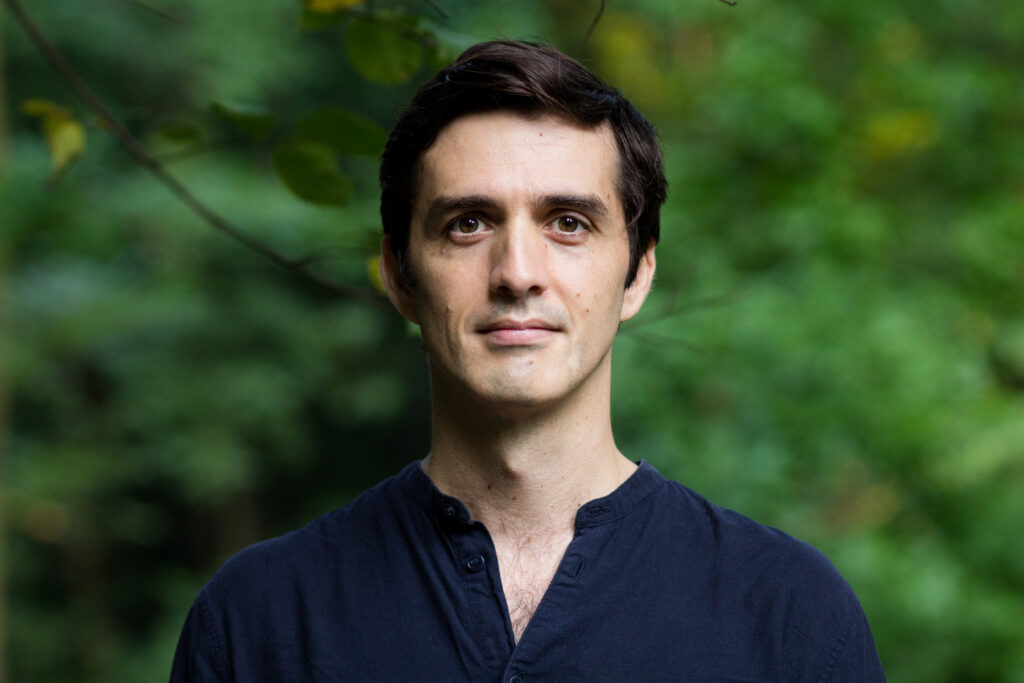
I am Alejandro de Castro Mazarro, a Spanish architect currently working in Dresden, Germany, as a postdoctoral researcher at the Leibniz Institute of Ecological Urban and Regional Development (IOER).
My interest in POLLEN has developed progressively. As an architecture student, I became interested in why the solutions to problems in informal settlements, designed by elite offices and showcased in mainstream architectural outlets, were not being broadly applied—looking back, thinking about it in those terms feels a bit naive. However, this initial curiosity made me aware that humanitarian architecture within mainstream architecture culture followed underpinning liberal political discourses. My PhD dissertation centred on this very topic: a historical characterisation of spatial interventions for informal settlements according to their underlying narrative. One of my key findings was that while many projects targeted the problem of inequality, the interventions themselves merely responded to poverty. Under structural conditions of inequality, this misalignment inevitably led to the failure of many such projects. This realisation drew me to the work of Marta Caldeira, David Harvey, Joan Martinez-Alier, and Neil Brenner, which provided me with a solid theoretical foundation for a political understanding of space.
Inequality is notoriously difficult to represent spatially because it is a relational fact. As someone visually trained to describe space, I have become deeply interested in representing and mapping the inequalities that occur across distant territories — a.k.a. global environmental injustices. To approach this, I am partially aligning my work with that of Eyal Weizman to uncover the material traces of injustice. Methodologically, however, I am applying a method used in industrial ecology and supply chain management to achieve a political ecology finding: supply chain network analysis. With this, I can trace resource flows extracted in the Global South and consumed in the Global North. In particular, I am researching the geographical origins of the construction steel and timber used in Germany. Transitioning into this quantitative territory is methodologically challenging, both in its own right and also because my background lies in qualitative research and critical discourse analysis. Yet, it is quite fascinating; it feels as though I am hunting for a “smoking gun” that can provide material evidence that global environmental injustices originate and manifest in concrete geographies.
I am truly excited to meet people at POLLEN who share a similar interest in tracing injustice and inequality spatially or materially. Additionally, I am eager to learn about foresight research being done within political ecology to help envision just urban scenarios. I am very much looking forward to the network!