The absurdity of what we live is beyond imagination
Livia Perosino
University of Bristol
The absurdity of what we live is beyond imagination.
After two weeks of conferences (first the BRISMES conference in London, then the POLLEN conference in Barcelona), meeting incredible people in the capitals of Europe – incredibly hot capitals – for the second heatwave in a summer that has just started. In London, it was 38 degrees. In Paris, it was 43. By the time I arrived in Barcelona, the temperatures were lower, even though they remained above the seasonal average. Almost a week later, the last night I was spending in Barcelona after the end of the POLLEN 2026 conference, I felt that the temperatures were rising again. I didn’t leave the AC at night, even though I had used it to cool the room before sleeping. That night, it felt like Paris again, I slept naked above the sheet because any fabric on my skin would have been too much. Climate scientists’ predictions about the return of El Niño are proving true.
Despite arriving early at Barcelona Sants on Saturday morning, it was clear that the day was going to be hot. The train left around 9h30, but the landscape outside the window already appeared foggy. It looked like the hottest days of August in Italy when I was little, when in the middle of the day it would become so hot that the evaporating humidity would blur the horizon. Now the hottest days of August can occur at any time.
The worst thing is that we’re normalising it. We have to. When I was in Paris around the 29th of June complaining about the weather (the 43 degrees), my mother compared the situation with that of my house in the countryside of central Italy: “It’s hot, but not too hot. It’s only 37-38”. The hottest days of August are not the hottest days of the year anymore, they’re not in August anymore, they have turned in relatively fresh days.
Not long after leaving Barcelona, I saw a big cloud of smoke rising from the horizon. The train started accumulating more and more delay. In Béziers, they made us switch trains. All the people from the train to Paris were to move to the train that was originally meant to go to Barcelona, and vice versa. Chaos, with elderly people that could not walk or stand for a long time, with parents with children and strollers, while the heat kept rising. Rail infrastructure doesn’t seem to do well with high temperatures. I had decided to travel by train from Bristol to Barcelona, and back, but the number of delays and trains being cancelled made me (almost) regret my decision several times.
Between Nimes and Valence, another cloud of smoke started rising in the sky, first black and then lighter and lighter, like trees burning. I kept looking at it horrified, horrified by the idea of trees burning, horrified by the fact that only a few people distractedly looked out the window. I kept looking, as if my interest in the fire could actually change something to the fact that something big was definitely burning.
In the impossibility of getting out of my own paradigm of understanding of the world, when the loudspeaker transmitted a new announcement, I naturally thought they would say something about the fire. Instead, the feminine voice declared that our delay was now 2h30. The screen in the coach was alerting passengers around the importance of recycling. The person sitting next to me was choosing teacups on sale on Veepee.
The absurdity of what we live is beyond my imagination. Often I feel alone and isolated, afraid that my thoughts could affect other people’s emotional stability and sanity. Often I prefer to remain silent rather than expressing my views on the future. Often, when I’m tired, I cry alone, so the people that I love would not be affected by my despair. When summers are really hot, I look at the trees and I worry, alone.
The isolation has become even more isolating since I moved back to Europe, five days before the beginning of the ongoing genocide in Gaza. If you come from the bilad as-sham – region that you will probably know with the term “Middle-East” – you share my dire outlook on the future, distrust in States and international institutions, and some kind of underlying bitterness that is rooted in laughter and jokes. The genocide has scattered the last bits of optimism, and thrown fuel on the anger, the frustration and the sense of injustice, the despair, the fear, and all the new feelings that have emerged, that we yet have to coin new words to describe.
At POLLEN, like at the BRISMES conference in London the week before, I met new and old people who come from the bilad as-sham, or who have left a piece of their heart there. Being surrounded by these people is a privilege because of the quality of their work and because each conversation is a constant source of inspiration. Meeting in Barcelona becomes even more special when you’re aware of how difficult it is to travel when you don’t have a passport from the Global North, or – even more so – when you live in the West Bank, you need the approval of both Israeli and Jordanian authorities to travel, and you need to be lucky enough that the many uncertainties don’t prevent you from crossing the King Hussein bridge on time for your flight1. However, the reason why I feel better around the people working on the region is because – in most cases – we share the same baseline2.
This common baseline has become more and more fundamental as we realised that for some people, not all people are people. Not all babies are babies. That the death of certain people and babies can be considered less grave than the death of other – often whiter – people and babies. In the context of the genocide, I found myself isolated in disbelief, hearing how people could feel entitled to speak about a reality they knew nothing about. Surprised to have to explain to people that define themselves as “decolonialists” that there was no possible excuse for what was happening in Gaza. Horrified that condemning one political movement became more important than to condemn a whole genocide. In Europe, the indifference – at best – and the dehumanising sentences pronounced light-heartedly – at worst – became isolating. The common baseline became a necessary precondition to have conversations, to connect, to feel human.
Since then, the situation in the South of Lebanon has made clear that, when you think that the worst is already unfolding under your very eyes, it can always get worst. In the last weeks, seeing entire villages explode, with the bursting laughter of Israeli soldiers celebrating their achievement in the background3, makes you think a lot about what it takes to create empathy, but most importantly about what it takes to tear empathy out of people.
The genocide has blended both my isolations together. My anxiety around the state of our environment and our possibility (or dystopies) of survival, in a context in which carbon emissions have not stopped rising. The lack of words in the face of the expansion of Israel’s inhuman development model, which is simultaneously at war with nature and humans4. Genocide and ecocide are both the outcome of the process of financialisation and militarisation5, concentration of money and power, increasing disconnection between us and others, between us and nature, but most importantly between the interest of the 99% of the population and the 1% of the richest.
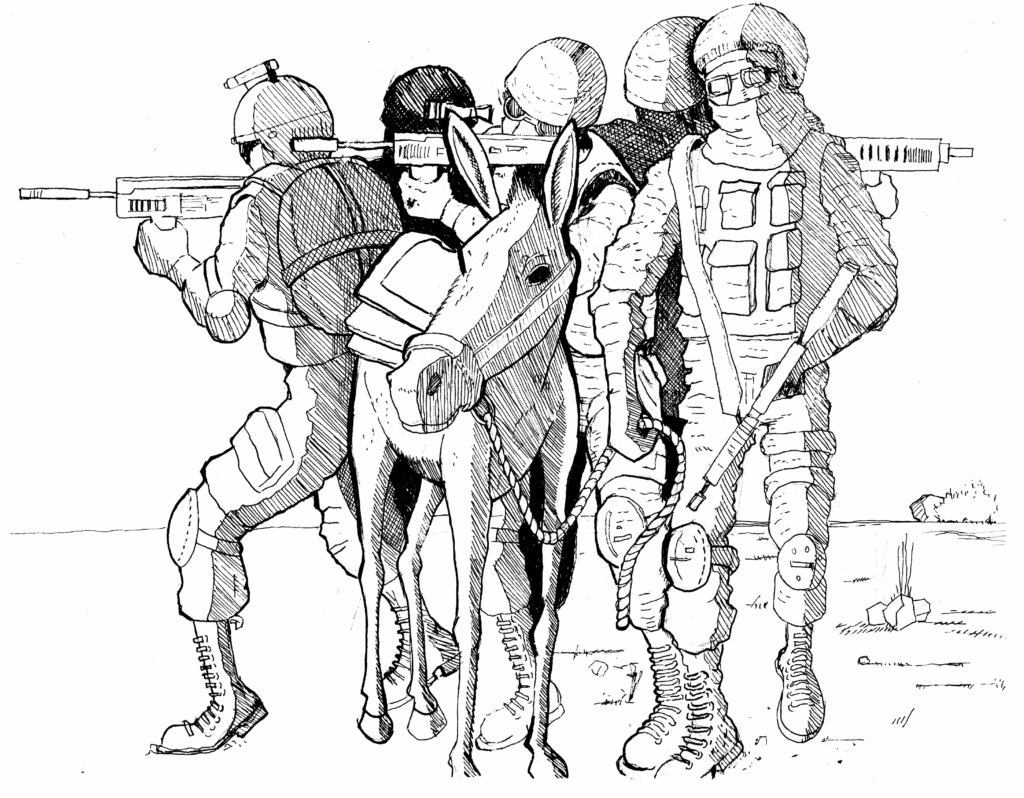
Caption: “Arresting the donkey”, by Palestinian political ecologist and artist Samir Harb
From blending different forms of isolation, solidarity, empathy and care have flourished. Movements have come together. People have exchanged and connected starting from the same baseline: a human is a human no matter what, and no life is worth more than another; preserving other forms of life (other-than-human) is sacred, has become more essential than ever to our survival, and can not be subjected to the demands of markets and profit. Also, consumption, addictions, screens and technology no not make us happier. If ever, they create more distance and isolation.
Despite the rapidity and the constant lack of time, this year’s POLLEN conference made me feel that connection was still possible, with a greater number of people than I would have thought. With a common baseline, communicating and understanding is possible. But for that to happen, we need to prioritise solidarity, empathy and care over anything else. We need to find the strength in us to leave our differences aside, to realise how much we have in common, despite how painful and hard that might be. We need to get over our addictions (including when it comes to phones and screens), and work on our contradictions. We need to do that not because of some liberal moral bullshit, or because of the capitalist imperative for performance. We need to find the strength because the future is scary, but it does become less dire when we’re not alone.
1 There is no airport in the West Bank, and people living there and only holding a Palestinian ID are not allowed to cross into the occupied ’48 territories (unless they obtain exceptional permits, the most common ones only allowing to cross into East Jerusalem) to travel from Ben Gurion airport. Therefore, the only way to travel abroad is to cross the Jordanian border – the most common crossing point being the King Hussein bridge (also called Allenby bridge, from the name of the British general Edmund Allenby). In order to travel, Palestinians need to obtain travel permits from both the Israeli and the Jordanian authorities. The number of people that can cross per day is limited – and sometimes authorities arbitrarily decide to lower that number even further -, the bridge closes during shabbat, and questioning, harassment and humiliation are commonly experienced during the security checks implemented by Israeli airport authorities.
2 A special thanks to Taraf Abu Hamdan, who introduced me to the Arabic term ثوابت, ṯwābt, which in English can be translated as baseline, fundamentals, maxims.
3 At this year’s BRISMES conference in London, we attended Munira Khayyat’s narration of these last years of war and destruction in South Lebanon. Munira’s presentation started with a video posted on social media by Israeli soldiers, showing the complete destruction of the village where Munira had carried out ethnographic work for years. Obviously, for many that was the village where they were born, grew up and took care of the land season after season. The village complete annihilation and the newly signed peace treaty between Israel and Lebanon means exile, derooting from their family histories and from their land.
4 The connection in between these two would be obvious to anyone trying to follow the BDS guidelines to the best of their capacity: when I started boycotting companies supporting the Israeli apartheid regime, I realised that I was already boycotting them for environmental reasons (on top of the list you find Nestlé, McDonald, Coca-Cola, Amazon to name a few).
5 See Akçagün-Narin and Yavuz Elveren, 2023; Gilbert, 2023; Bloom, 2025; and the report of the United Nations Special Rapporteur Francesca Albanese, “From economy of occupation to economy of genocide”, 2025.